Ch.10 - Structure and Synthesis of Alcohols
Wade - Organic Chemistry 9th Edition
Wade9th EditionOrganic ChemistryISBN: 9780135213728당신이 사용하는 게 아니라요?교과서 변경
10장, 문제 60c,d

Problem 8-54 describes a new method to perform ozonolysis reactions that used pyridine (py) to generate the final aldehydes and ketones in a non-aqueous reaction medium. In a subsequent publication (J. Org. Chem., 2013, 78, 42), Professor Dussault (U. of Nebraska at Lincoln) described a “tandem” process in which two reactions are performed sequentially without having to isolate the intermediate aldehyde or ketone. Show the final product from each sequence. (Hint: The isolated products were from the larger part of the structure. Ignore stereochemistry.)
(c) Chemical structure showing ozonolysis reaction steps with reagents O3, pyridine, CH3MgBr, and H3O+ for product formation.
(d) Chemical reaction scheme illustrating ozonolysis with pyridine, followed by Grignard reagent and acid workup steps.

검증된 단계별 안내
1
Step 1: Analyze the first reaction condition (O₃, py, -78 °C). This is an ozonolysis reaction, which cleaves the double bond in the alkene and forms two carbonyl compounds (aldehydes or ketones). Identify the location of the double bond in the given structure and predict the cleavage products.
Step 2: For the first image, the double bond in the cyclohexane ring will be cleaved, resulting in two carbonyl compounds. The larger part of the structure will retain the bulky substituents and the methoxy group. For the second image, the double bond in the bicyclic structure will be cleaved, forming two carbonyl compounds, with the larger part retaining the bulky substituents.
Step 3: Analyze the second reaction condition (CH₃MgBr or PhMgBr). This is a Grignard reaction, where the Grignard reagent adds to the carbonyl group (aldehyde or ketone) to form an alcohol. For the first image, CH₃MgBr will add a methyl group to the carbonyl compound. For the second image, PhMgBr will add a phenyl group to the carbonyl compound.
Step 4: Analyze the third reaction condition (H₃O⁺). This is an acid workup step, which protonates the alkoxide intermediate formed in the Grignard reaction, resulting in the final alcohol product.
Step 5: Combine the results of all steps to predict the final product for each sequence. For the first image, the final product will be an alcohol with a methyl group added to the larger part of the structure. For the second image, the final product will be an alcohol with a phenyl group added to the larger part of the structure.

비슷한 문제에 대한 검증된 영상 답변:

이 영상 해법은 위 문제에 도움이 된다고 튜터들이 추천한 것입니다.
영상 길이:
9m
도움이 되었나요?

주요 개념

질문에 올바르게 답하기 위해 반드시 이해해야 하는 핵심 개념들은 다음과 같습니다.

Ozonolysis

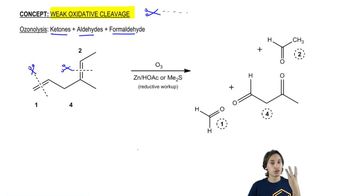
Ozonolysis is a reaction involving the cleavage of alkenes or alkynes using ozone (O3) to form carbonyl compounds, such as aldehydes and ketones. The reaction typically proceeds through the formation of a cyclic ozonide intermediate, which is then reduced to yield the final products. Understanding this process is crucial for predicting the outcomes of ozonolysis reactions and the types of carbonyl compounds generated.
추천 영상:
06:30
General properties of ozonolysis.

Tandem Reactions

Tandem reactions, also known as one-pot reactions, involve performing multiple chemical transformations sequentially without isolating intermediates. This approach can enhance efficiency and reduce the number of purification steps required. In the context of the problem, recognizing how the tandem ozonolysis and subsequent reactions yield final products is essential for understanding the overall reaction mechanism.
추천 영상:
02:56
Overview of Cross-Coupling General Reactions Example 1

Non-Aqueous Reaction Medium

A non-aqueous reaction medium is a solvent system that does not contain water, which can significantly influence the reactivity and selectivity of chemical reactions. In ozonolysis, using a non-aqueous medium like pyridine can stabilize intermediates and affect the final products. Understanding the role of the solvent is important for predicting the behavior of reactants and the nature of the products formed in the reaction.
추천 영상:
06:42
Understanding Non-IUPAC Substituents