Ch.10 - Structure and Synthesis of Alcohols
Wade - Organic Chemistry 9th Edition
Wade9th EditionOrganic ChemistryISBN: 9780135213728당신이 사용하는 게 아니라요?교과서 변경
10장, 문제 58b

For each synthesis, start with bromocyclohexane and predict the products. Assume that an excess of each reactant is added so that all possible reactions that can happen will happen.
(b)

검증된 단계별 안내
1
Step 1: Analyze the first reaction. Bromocyclohexane reacts with KOH in ethanol under heat (Δ). This is an elimination reaction where the bromine atom is removed, and a double bond is formed in the cyclohexane ring, resulting in cyclohexene (compound A).
Step 2: Examine the second reaction. Cyclohexene (compound A) reacts with KMnO4 in NaOH under heat (Δ). This is an oxidative cleavage reaction where the double bond in cyclohexene is broken, forming a dicarboxylic acid (compound E).
Step 3: Consider the third reaction. The dicarboxylic acid (compound E) is treated with LiAlH4 in ether. LiAlH4 is a strong reducing agent that reduces carboxylic acids to primary alcohols, resulting in a diol (compound F).
Step 4: The final step involves the diol (compound F) being treated with dilute H3O+. This step ensures the reaction is complete and neutralizes any remaining basic conditions from the previous step.
Step 5: Summarize the transformations. Bromocyclohexane undergoes elimination to form cyclohexene, oxidative cleavage to form a dicarboxylic acid, and reduction to form a diol, followed by neutralization.

비슷한 문제에 대한 검증된 영상 답변:

이 영상 해법은 위 문제에 도움이 된다고 튜터들이 추천한 것입니다.
영상 길이:
5m

주요 개념

질문에 올바르게 답하기 위해 반드시 이해해야 하는 핵심 개념들은 다음과 같습니다.

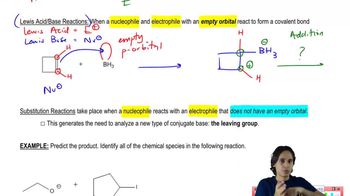
Nucleophilic Substitution

Nucleophilic substitution is a fundamental reaction in organic chemistry where a nucleophile replaces a leaving group in a molecule. In this case, bromocyclohexane undergoes nucleophilic substitution with KOH in ethanol, leading to the formation of an alcohol. Understanding this mechanism is crucial for predicting the products of the reaction and the subsequent steps in the synthesis.
추천 영상:
01:47
Nucleophiles and Electrophiles can react in Substitution Reactions.

Oxidation Reactions

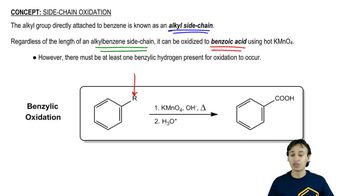
Oxidation reactions involve the increase of oxidation state of a molecule, often through the addition of oxygen or the removal of hydrogen. In the provided synthesis, the intermediate A is oxidized using KMnO4 in a basic medium, which typically converts alcohols to carbonyl compounds or carboxylic acids. Recognizing the role of oxidizing agents is essential for predicting the transformation of intermediates in organic synthesis.
추천 영상:
03:20
Benzylic Oxidation

Reduction Reactions

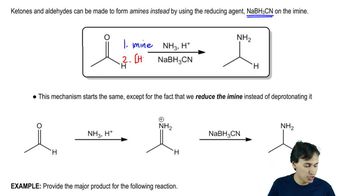
Reduction reactions are processes that decrease the oxidation state of a molecule, often involving the addition of hydrogen or the removal of oxygen. In this synthesis, LiAlH4 is used to reduce the carbonyl compound E to an alcohol F. Understanding reduction mechanisms is vital for determining how functional groups can be transformed in organic synthesis.
추천 영상:
07:12
Reductive Amination
관련 실천
교과서 질문

Show how this 1° alcohol can be made from the following:

(c) a 7-carbon aldehyde

(d) a carboxylic acid

854
views

교과서 질문

For each synthesis, start with bromocyclohexane and predict the products. Assume that an excess of each reactant is added so that all possible reactions that can happen will happen.

(c)

899
views
교과서 질문

Problem 8-54 describes a new method to perform ozonolysis reactions that used pyridine (py) to generate the final aldehydes and ketones in a non-aqueous reaction medium. In a subsequent publication (J. Org. Chem., 2013, 78, 42), Professor Dussault (U. of Nebraska at Lincoln) described a “tandem” process in which two reactions are performed sequentially without having to isolate the intermediate aldehyde or ketone. Show the final product from each sequence. (Hint: The isolated products were from the larger part of the structure. Ignore stereochemistry.)

(c)

(d)

849
views
교과서 질문

For each synthesis, start with bromocyclohexane and predict the products. Assume that an excess of each reactant is added so that all possible reactions that can happen will happen.

(a)

1630
views
교과서 질문

Problem 8-54 describes a new method to perform ozonolysis reactions that used pyridine (py) to generate the final aldehydes and ketones in a non-aqueous reaction medium. In a subsequent publication (J. Org. Chem., 2013, 78, 42), Professor Dussault (U. of Nebraska at Lincoln) described a “tandem” process in which two reactions are performed sequentially without having to isolate the intermediate aldehyde or ketone. Show the final product from each sequence. (Hint: The isolated products were from the larger part of the structure. Ignore stereochemistry.)

(a)

(b)

1018
views
교과서 질문

Show how this 1° alcohol can be made from the following:

(e) an alkene

(f) ethylene oxide

863
views