Ch.10 - Structure and Synthesis of Alcohols
Wade - Organic Chemistry 9th Edition
Wade9th EditionOrganic ChemistryISBN: 9780135213728당신이 사용하는 게 아니라요?교과서 변경
10장, 문제 40d

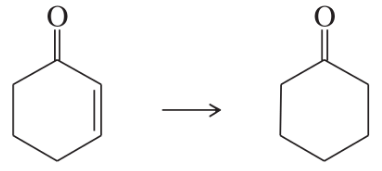
Show how you would accomplish the following transformations. You may use any additional reagents you need.
(d)

검증된 단계별 안내
1
Step 1: Analyze the transformation. The starting material is a cyclohexenone (a cyclic ketone with an α,β-unsaturated double bond), and the product is cyclohexanone (a saturated cyclic ketone). This indicates that the double bond in the α,β-position needs to be reduced.
Step 2: Select an appropriate reagent for the reduction of the α,β-unsaturated double bond. A common choice is catalytic hydrogenation using H₂ gas and a metal catalyst such as palladium on carbon (Pd/C). This method selectively reduces the double bond without affecting the ketone group.
Step 3: Alternatively, if selective reduction of the double bond is required without using hydrogen gas, you can use a chemical reagent like sodium borohydride (NaBH₄) in the presence of a protic solvent, or lithium aluminum hydride (LiAlH₄) under controlled conditions.
Step 4: Perform the reaction under the chosen conditions. For catalytic hydrogenation, the reaction is typically carried out under atmospheric or slightly elevated pressure of H₂ gas in the presence of the catalyst. For chemical reduction, ensure the solvent and temperature are appropriate to avoid over-reduction.
Step 5: Confirm the product formation. Use spectroscopic techniques such as IR or NMR to verify the disappearance of the double bond and the retention of the ketone group in the product.

비슷한 문제에 대한 검증된 영상 답변:

이 영상 해법은 위 문제에 도움이 된다고 튜터들이 추천한 것입니다.
영상 길이:
3m

주요 개념

질문에 올바르게 답하기 위해 반드시 이해해야 하는 핵심 개념들은 다음과 같습니다.

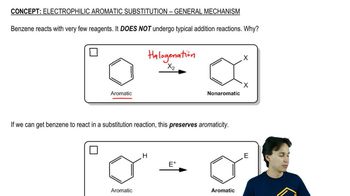
Electrophilic Aromatic Substitution

Electrophilic aromatic substitution (EAS) is a fundamental reaction in organic chemistry where an electrophile replaces a hydrogen atom on an aromatic ring. This process is crucial for modifying aromatic compounds, allowing for the introduction of various functional groups. Understanding the mechanism of EAS, including the formation of the sigma complex and the role of catalysts, is essential for predicting the outcomes of transformations involving aromatic systems.
추천 영상:
03:07
EAS Review

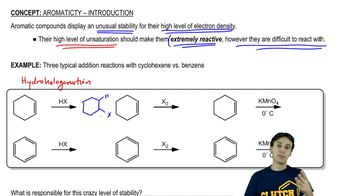
Reactivity of Aromatic Compounds

Aromatic compounds, characterized by their stable ring structure and delocalized pi electrons, exhibit unique reactivity patterns compared to aliphatic compounds. The presence of substituents on the aromatic ring can influence the reactivity and orientation of subsequent reactions, such as EAS. Recognizing how electron-donating or electron-withdrawing groups affect the stability of intermediates is vital for understanding the transformations depicted in the question.
추천 영상:
08:19
Intro to Aromaticity

Oxidation and Reduction Reactions

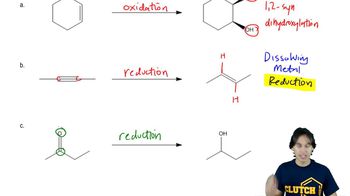
Oxidation and reduction reactions are key processes in organic chemistry that involve the transfer of electrons between species. In the context of the transformation shown, understanding how to oxidize or reduce functional groups, such as converting alcohols to carbonyls or vice versa, is essential. Familiarity with common reagents and conditions for these reactions enables chemists to manipulate molecular structures effectively.
추천 영상:
00:54
Distinguishing between Oxidation and Reduction