Ch.10 - Structure and Synthesis of Alcohols
Wade - Organic Chemistry 9th Edition
Wade9th EditionOrganic ChemistryISBN: 9780135213728당신이 사용하는 게 아니라요?교과서 변경
10장, 문제 40b

Show how you would accomplish the following transformations. You may use any additional reagents you need.
(b)

검증된 단계별 안내
1
Step 1: Recognize the functional group transformation. The starting material contains a thiol group (-SH), and the product contains a sulfonic acid group (-SO₃H). This indicates that the thiol group needs to be oxidized to a sulfonic acid.
Step 2: Select an appropriate oxidizing agent. Common oxidizing agents for thiols to sulfonic acids include hydrogen peroxide (H₂O₂) in acidic conditions or potassium permanganate (KMnO₄). These reagents can facilitate the oxidation of the thiol group.
Step 3: Set up the reaction conditions. For example, if using H₂O₂, the reaction can be carried out in an acidic medium such as dilute sulfuric acid (H₂SO₄) to ensure the formation of the sulfonic acid group.
Step 4: Perform the oxidation reaction. The thiol group (-SH) undergoes sequential oxidation steps: first to a sulfenic acid (-SOH), then to a sulfinic acid (-SO₂H), and finally to a sulfonic acid (-SO₃H). Ensure the reaction proceeds to completion.
Step 5: Purify the product. After the reaction, isolate the cyclohexanesulfonic acid by techniques such as recrystallization or extraction, depending on the reaction medium used.

비슷한 문제에 대한 검증된 영상 답변:

이 영상 해법은 위 문제에 도움이 된다고 튜터들이 추천한 것입니다.
영상 길이:
1m

주요 개념

질문에 올바르게 답하기 위해 반드시 이해해야 하는 핵심 개념들은 다음과 같습니다.

Thiol Chemistry

Thiol compounds, characterized by the presence of a sulfhydryl group (-SH), are analogous to alcohols but contain sulfur instead of oxygen. They can undergo various chemical transformations, including oxidation, where the thiol group can be converted into sulfonic acids. Understanding the reactivity of thiols is crucial for predicting the products of their transformations.
추천 영상:
03:21
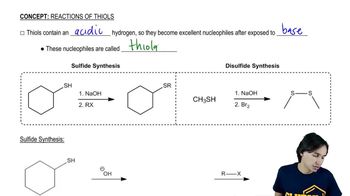
The mechanism of Sulfide Synthesis.

Oxidation Reactions

Oxidation reactions involve the loss of electrons or an increase in oxidation state, often resulting in the formation of more oxidized products. In the case of thiols, oxidation can lead to the formation of sulfonic acids, which are highly polar and soluble in water. Recognizing the types of reagents that facilitate oxidation, such as hydrogen peroxide or peracids, is essential for performing these transformations.
추천 영상:
03:20
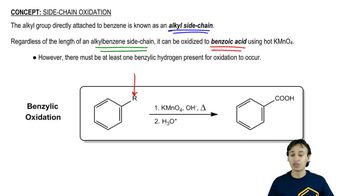
Benzylic Oxidation

Sulfonic Acids

Sulfonic acids are organic compounds containing a sulfonyl group (-SO3H) attached to a carbon atom. They are strong acids and are often used in various applications, including as intermediates in organic synthesis and as surfactants. Understanding their properties and how they are formed from thiols through oxidation is key to mastering organic transformations involving sulfur-containing compounds.
추천 영상:
04:33
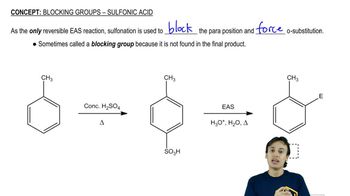
Forcing Ortho substitution