Ch.10 - Structure and Synthesis of Alcohols
Wade - Organic Chemistry 9th Edition
Wade9th EditionOrganic ChemistryISBN: 9780135213728당신이 사용하는 게 아니라요?교과서 변경
10장, 문제 44b

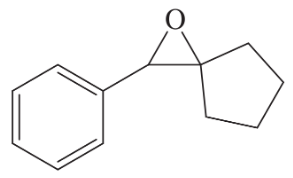
Show how you would synthesize the following compounds from any starting materials containing no more than six carbon atoms.
(b)

검증된 단계별 안내
1
Step 1: Analyze the target molecule. The compound is a ketone with a cyclopentyl group and a phenyl group attached to the carbonyl carbon. This suggests that the synthesis will involve forming a ketone and attaching the two groups to the carbonyl carbon.
Step 2: Choose starting materials with no more than six carbons. For the phenyl group, benzene or a derivative like bromobenzene can be used. For the cyclopentyl group, cyclopentane or cyclopentyl bromide can be used.
Step 3: Use Friedel-Crafts acylation to introduce the phenyl group. React benzene with an acyl chloride (e.g., acetyl chloride) in the presence of AlCl₃ to form acetophenone. This introduces the phenyl group attached to a carbonyl group.
Step 4: Prepare the cyclopentyl group. Cyclopentyl bromide can be synthesized from cyclopentane using bromination. Then, use a Grignard reaction to attach the cyclopentyl group to the carbonyl carbon of acetophenone. React cyclopentyl magnesium bromide with acetophenone to form the desired ketone.
Step 5: Purify the product. Use techniques like distillation or recrystallization to isolate and purify the final compound. Confirm the structure using spectroscopic methods such as NMR or IR.

비슷한 문제에 대한 검증된 영상 답변:

이 영상 해법은 위 문제에 도움이 된다고 튜터들이 추천한 것입니다.
영상 길이:
11m

주요 개념

질문에 올바르게 답하기 위해 반드시 이해해야 하는 핵심 개념들은 다음과 같습니다.

Functional Groups

Functional groups are specific groups of atoms within molecules that are responsible for the characteristic chemical reactions of those molecules. Understanding the functional groups present in the target compounds is essential for determining the appropriate reactions and starting materials needed for synthesis.
추천 영상:
02:36
Identifying Functional Groups

Reaction Mechanisms

Reaction mechanisms describe the step-by-step process by which reactants are converted into products. Familiarity with common mechanisms, such as nucleophilic substitution or elimination reactions, is crucial for predicting how to construct the desired compounds from simpler starting materials.
추천 영상:
02:16
Heck Reaction Mechanism

Retrosynthetic Analysis

Retrosynthetic analysis is a strategy used in organic synthesis to deconstruct a target molecule into simpler precursor structures. This approach helps chemists identify viable starting materials and the necessary reactions to achieve the desired compound, making it a fundamental tool in synthetic organic chemistry.
추천 영상:
01:22
Retrosynthesis