Ch.11 - Reactions of Alcohols
Wade - Organic Chemistry 9th Edition
Wade9th EditionOrganic ChemistryISBN: 9780135213728당신이 사용하는 게 아니라요?교과서 변경
11장, 문제 33

A good Williamson synthesis of ethyl methyl ether would be

What is wrong with the following proposed synthesis of ethyl methyl ether? First, ethanol is treated with acid to protonate the hydroxy group (making it a good leaving group), and then sodium methoxide is added to displace water.

검증된 단계별 안내
1
Step 1: Understand the Williamson synthesis mechanism. It involves the reaction of an alkoxide ion (nucleophile) with a primary alkyl halide (electrophile) to form an ether. The reaction proceeds via an SN2 mechanism, which requires a good nucleophile and a suitable leaving group.
Step 2: Analyze the proposed synthesis. Ethanol is treated with acid to protonate the hydroxyl group, forming water as a leaving group. Sodium methoxide is then added to displace water and form ethyl methyl ether.
Step 3: Identify the issue with the proposed synthesis. Protonating ethanol with acid creates a positively charged intermediate, which is prone to elimination reactions rather than substitution. This is because the acidic conditions favor the formation of alkenes via E1 elimination rather than the desired ether via SN2 substitution.
Step 4: Consider the role of sodium methoxide. Sodium methoxide is a strong base and nucleophile. Under acidic conditions, it may react with the protonated ethanol to form an alkene instead of displacing the leaving group to form the ether.
Step 5: Suggest a better approach. A good Williamson synthesis of ethyl methyl ether would involve using sodium ethoxide (the alkoxide ion) and methyl iodide (a primary alkyl halide with a good leaving group, iodide). This setup ensures an SN2 reaction proceeds efficiently to form the desired ether.

비슷한 문제에 대한 검증된 영상 답변:

이 영상 해법은 위 문제에 도움이 된다고 튜터들이 추천한 것입니다.
영상 길이:
3m
도움이 되었나요?

주요 개념

질문에 올바르게 답하기 위해 반드시 이해해야 하는 핵심 개념들은 다음과 같습니다.

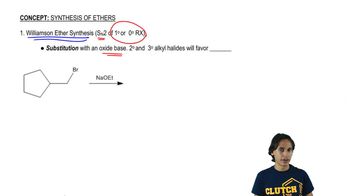
Williamson Ether Synthesis

The Williamson ether synthesis is a method for creating ethers through the nucleophilic substitution of an alkoxide ion with a primary alkyl halide. This reaction typically involves the deprotonation of an alcohol to form an alkoxide, which then acts as a nucleophile to attack an electrophilic carbon in an alkyl halide, resulting in ether formation. The choice of reactants and conditions is crucial for the success of this synthesis.
추천 영상:
03:50
The Mechanism of Williamson Ether Synthesis.

Protonation of Alcohols

Protonation of alcohols involves the addition of a proton (H+) to the hydroxyl group (-OH), converting it into a better leaving group, typically water (H2O). This process is essential in reactions where the alcohol is transformed into a more reactive species, facilitating nucleophilic substitution. However, protonation can lead to carbocation formation, which may result in rearrangements or elimination reactions instead of the desired substitution.
추천 영상:
01:01
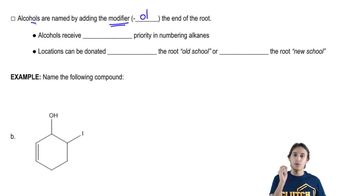
How to name alcohols

Nucleophilic Substitution Mechanisms

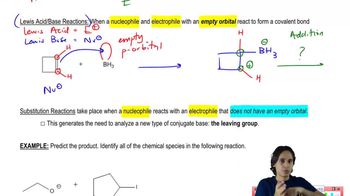
Nucleophilic substitution mechanisms, such as SN1 and SN2, describe how nucleophiles replace leaving groups in organic reactions. In SN2 reactions, a strong nucleophile attacks the electrophilic carbon simultaneously as the leaving group departs, leading to a concerted mechanism. In contrast, SN1 involves the formation of a carbocation intermediate, followed by nucleophilic attack. Understanding these mechanisms is vital for predicting the outcomes of reactions involving ethers and alcohols.
추천 영상:
01:47
Nucleophiles and Electrophiles can react in Substitution Reactions.
관련 실천
교과서 질문

Use resonance forms of the conjugate bases to explain why methanesulfonic acid (CH3SO3H, pKa = –2.6) is a much stronger acid than acetic acid (CH3COOH, pKa = 4.8).

1083
views

교과서 질문

A student wanted to use the Williamson ether synthesis to make (R)-2-ethoxybutane. He remembered that the Williamson synthesis involves an SN2 displacement, which takes place with inversion of configuration. He ordered a bottle of (S)-butan-2-ol for his chiral starting material. He also remembered that the SN2 goes best on primary halides and tosylates, so he made ethyl tosylate and sodium (S)-but-2-oxide. After warming these reagents together, he obtained an excellent yield of 2-ethoxybutane.

a. What enantiomer of 2-ethoxybutane did he obtain? Explain how this enantiomer results from the SN2 reaction of ethyl tosylate with sodium (S)-but-2-oxide.

b. What would have been the best synthesis of (R)-2-ethoxybutane?

c. How can this student convert the rest of his bottle of (S)-butan-2-ol to (R)-2-ethoxybutane?

966
views
교과서 질문

(a) Show how ethanol and cyclohexanol may be used to synthesize cyclohexyl ethyl ether (tosylation followed by the Williamson ether synthesis).

(b) Why can't we synthesize this product simply by mixing the two alcohols, adding some sulfuric acid, and heating?

1632
views
교과서 질문

Show the alcohol and the acid chloride that combine to make the following esters.

(c)

(d)

725
views
교과서 질문

Phenols (pKa ≈ 10) are more acidic than other alcohols, so they are easily deprotonated by sodium hydroxide or potassium hydroxide. The anions of phenols (phenoxide ions) can be used in the Williamson ether synthesis, especially with very reactive alkylating reagents such as dimethyl sulfate. Using phenol, dimethyl sulfate, and other necessary reagents, show how you would synthesize methyl phenyl ether.

1485
views
교과서 질문

Predict the products formed by periodic acid cleavage of the following diols.

(c)

(d)

969
views