Ch.11 - Reactions of Alcohols
Wade - Organic Chemistry 9th Edition
Wade9th EditionOrganic ChemistryISBN: 9780135213728당신이 사용하는 게 아니라요?교과서 변경
11장, 문제 48d,e,f

Show how you would make each compound, beginning with an alcohol of your choice.
(d)
(e)
(f) Chemical structure of a carbon compound with a hydroxyl group and a carbonyl group, illustrating oxidation of an alcohol.

검증된 단계별 안내
1
Step 1: Analyze the target compounds provided in the images. The first compound is a cyclohexane derivative with a chlorine and methyl group in trans configuration. The second compound is an ester with a cyclohexane ring and a methyl ketone group. The third compound is a carboxylic acid attached to a cyclopentane ring.
Step 2: For compound (d), start with cyclohexanol as the alcohol. Perform a substitution reaction using SOCl₂ or PCl₅ to replace the hydroxyl group (-OH) with a chlorine atom (-Cl). Then, use a stereoselective reaction to introduce the methyl group in the trans configuration relative to the chlorine.
Step 3: For compound (e), begin with cyclohexanol as the alcohol. Oxidize the alcohol to a ketone using an oxidizing agent like PCC (Pyridinium Chlorochromate). Then, perform a reaction with methyl acetate in the presence of an acid catalyst to form the ester group.
Step 4: For compound (f), start with cyclopentanol as the alcohol. Oxidize the alcohol to a carboxylic acid using a strong oxidizing agent such as KMnO₄ or CrO₃ under acidic conditions.
Step 5: Verify the stereochemistry and functional groups of the synthesized compounds using spectroscopic techniques like NMR and IR to ensure the desired products are obtained.

비슷한 문제에 대한 검증된 영상 답변:

이 영상 해법은 위 문제에 도움이 된다고 튜터들이 추천한 것입니다.
영상 길이:
4m

주요 개념

질문에 올바르게 답하기 위해 반드시 이해해야 하는 핵심 개념들은 다음과 같습니다.

Alcohols as Reactants

Alcohols are organic compounds containing one or more hydroxyl (-OH) groups. They serve as versatile starting materials in organic synthesis, allowing for various transformations such as oxidation, dehydration, and substitution reactions. Understanding the structure and reactivity of alcohols is crucial for designing synthetic pathways to target compounds.
추천 영상:
01:01
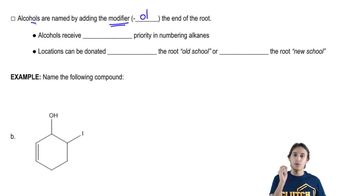
How to name alcohols

Functional Group Transformations

Functional group transformations involve converting one functional group into another through chemical reactions. This concept is essential in organic synthesis, as it allows chemists to modify the properties of molecules. For example, alcohols can be converted into aldehydes, ketones, or alkyl halides, depending on the desired product and reaction conditions.
추천 영상:
02:36
Identifying Functional Groups

Reaction Mechanisms

Understanding reaction mechanisms is vital for predicting the outcomes of chemical reactions. A mechanism outlines the step-by-step process by which reactants are converted into products, including the formation and breaking of bonds. Familiarity with common mechanisms, such as nucleophilic substitution or elimination, helps in rationalizing how to synthesize the desired compounds from alcohols.
추천 영상:
02:16
Heck Reaction Mechanism