
Ch. 14 - Ethers, Epoxides, and Thioethers
Wade - Organic Chemistry 9th Edition
Wade9th EditionOrganic ChemistryISBN: 9780135213728당신이 사용하는 게 아니라요?교과서 변경
14장, 문제 10e

Show how the following ethers might be synthesized using (1) alkoxymercuration– demercuration and (2) the Williamson synthesis. (When one of these methods cannot be used for the given ether, point out why it will not work.)
(e) 1-isopropoxy-1-methylcyclopentane

검증된 단계별 안내
1
Step 1: Understand the structure of the ether, 1-isopropoxy-1-methylcyclopentane. It consists of a cyclopentane ring with a methyl group and an isopropoxy group attached to the same carbon atom. This is a branched ether.
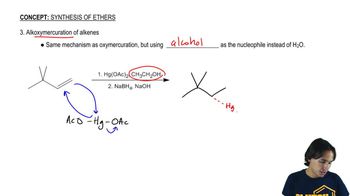
Step 2: For alkoxymercuration-demercuration, recall that this method involves the addition of an alcohol to an alkene in the presence of mercuric acetate and water, followed by reduction with sodium borohydride. Identify the corresponding alkene precursor for the ether. In this case, the precursor would be 1-methylcyclopentene, and the alcohol used would be isopropanol.
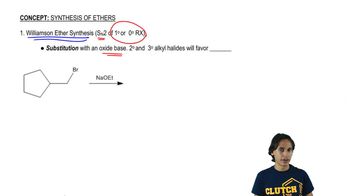
Step 3: For the Williamson synthesis, recall that this method involves the reaction of an alkoxide ion (RO⁻) with a primary alkyl halide (R-X) via an SN2 mechanism. Analyze the structure of the ether to determine the possible alkoxide and alkyl halide precursors. Here, the alkoxide would be isopropoxide (CH₃CH(CH₃)O⁻), and the alkyl halide would be 1-methylcyclopentyl bromide or chloride.
Step 4: Evaluate the feasibility of the Williamson synthesis for this ether. Since the carbon attached to the leaving group in 1-methylcyclopentyl bromide is tertiary, the SN2 mechanism is hindered due to steric hindrance. Therefore, the Williamson synthesis is not suitable for synthesizing this ether.
Step 5: Conclude that alkoxymercuration-demercuration is the preferred method for synthesizing 1-isopropoxy-1-methylcyclopentane, as it avoids the steric hindrance issues present in the Williamson synthesis.

비슷한 문제에 대한 검증된 영상 답변:

이 영상 해법은 위 문제에 도움이 된다고 튜터들이 추천한 것입니다.
영상 길이:
9m
도움이 되었나요?

주요 개념

질문에 올바르게 답하기 위해 반드시 이해해야 하는 핵심 개념들은 다음과 같습니다.

Alkoxymercuration-Demercuration

Alkoxymercuration-demercuration is a two-step reaction used to synthesize ethers. In the first step, an alkene reacts with mercuric acetate in the presence of an alcohol, leading to the formation of an alkoxymercurial intermediate. The second step involves the reduction of this intermediate, typically using sodium borohydride, to yield the desired ether. This method is particularly useful for synthesizing ethers from unsymmetrical alkenes.
추천 영상:
가이드 코스
04:21
The Mechanism of Alkoxymercuation.

Williamson Ether Synthesis

The Williamson ether synthesis is a classic method for preparing ethers through the nucleophilic substitution of an alkyl halide by an alkoxide ion. In this reaction, an alkoxide (derived from an alcohol) acts as a nucleophile and attacks a primary or secondary alkyl halide, resulting in the formation of an ether. This method is favored for its simplicity and effectiveness, especially with primary alkyl halides, but can be hindered by steric hindrance in secondary or tertiary halides.
추천 영상:
가이드 코스
03:50
The Mechanism of Williamson Ether Synthesis.

Steric Hindrance

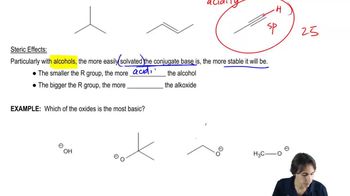
Steric hindrance refers to the prevention of chemical reactions due to the spatial arrangement of atoms within a molecule. In the context of ether synthesis, steric hindrance can affect the reactivity of alkyl halides in the Williamson synthesis, making it difficult to use bulky or tertiary halides. Understanding steric effects is crucial for predicting the feasibility of synthetic routes and selecting appropriate reactants for ether formation.
추천 영상:
가이드 코스
02:53
Understanding steric effects.
관련 실천
교과서 질문

Show how the following ethers might be synthesized using (1) alkoxymercuration– demercuration and (2) the Williamson synthesis. (When one of these methods cannot be used for the given ether, point out why it will not work.)

(d) 1-methoxy-1-methylcyclopentane

779
views
교과서 질문

Explain why bimolecular condensation is a poor method for making unsymmetrical ethers such as ethyl methyl ether.

850
views
교과서 질문

Show how you would use the Williamson ether synthesis to prepare the following ethers. You may use any alcohols or phenols as your organic starting materials.

(d) ethyl n-propyl ether (two ways)

(e) benzyl tert-butyl ether (benzyl = Ph–CH2–)

1235
views
교과서 질문

Show how the following ethers might be synthesized using (1) alkoxymercuration–demercuration and (2) the Williamson synthesis. (When one of these methods cannot be used for the given ether, point out why it will not work.)

f. tert-butyl phenyl ether

570
views
교과서 질문

Propose a mechanism for the acid-catalyzed condensation of n-propyl alcohol to n-propyl ether, as shown above. When the temperature is allowed to rise too high, propene is formed. Propose a mechanism for the formation of propene, and explain why it is favored at higher temperatures.

605
views
교과서 질문

Show how the following ethers might be synthesized using (1) alkoxymercuration– demercuration and (2) the Williamson synthesis. (When one of these methods cannot be used for the given ether, point out why it will not work.)

a. 2-methoxybutane

b. ethyl cyclohexyl ether

c. 1-methoxy-2-methylcyclopentane

1299
views