


Ch. 14 - Ethers, Epoxides, and Thioethers
Wade - Organic Chemistry 9th Edition
Wade9th EditionOrganic ChemistryISBN: 9780135213728당신이 사용하는 게 아니라요?교과서 변경
14장, 문제 46

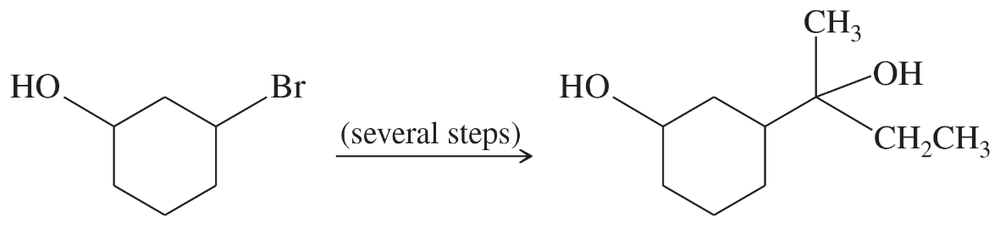
Show how you would convert 3-bromocyclohexanol to the following diol. You may use any additional reagents you need.

검증된 단계별 안내
1
Step 1: Begin by replacing the bromine atom in 3-bromocyclohexanol with a nucleophile to form a cyclohexanol derivative. This can be achieved using a substitution reaction, such as an SN2 reaction, with a suitable nucleophile like cyanide (CN⁻) to introduce a functional group that can be further modified.
Step 2: Perform a hydrolysis reaction on the nitrile group (if introduced in Step 1) to convert it into a carboxylic acid. This can be done using acidic or basic hydrolysis conditions.
Step 3: Reduce the carboxylic acid group to a primary alcohol using a reducing agent such as lithium aluminum hydride (LiAlH₄). This will yield a cyclohexanol derivative with an additional alcohol group.
Step 4: Introduce branching at the carbon adjacent to the hydroxyl group by performing an alkylation reaction. This can be achieved by converting the alcohol into a leaving group (e.g., tosylate) and then reacting it with an alkyl halide under basic conditions.
Step 5: Adjust the stereochemistry of the product, if necessary, by using selective reagents or conditions to ensure the desired diol configuration is achieved. This may involve epimerization or other stereoselective transformations.

비슷한 문제에 대한 검증된 영상 답변:

이 영상 해법은 위 문제에 도움이 된다고 튜터들이 추천한 것입니다.
영상 길이:
9m
도움이 되었나요?

주요 개념

질문에 올바르게 답하기 위해 반드시 이해해야 하는 핵심 개념들은 다음과 같습니다.

Nucleophilic Substitution

Nucleophilic substitution is a fundamental reaction in organic chemistry where a nucleophile attacks an electrophilic carbon atom, replacing a leaving group. In this case, the bromine atom in 3-bromocyclohexanol acts as a leaving group, allowing for the introduction of new functional groups through subsequent reactions. Understanding this mechanism is crucial for converting the starting material into the desired diol.
추천 영상:
01:47
Nucleophiles and Electrophiles can react in Substitution Reactions.

Reduction Reactions

Reduction reactions involve the gain of electrons or hydrogen, often resulting in the conversion of carbonyl groups to alcohols. In the context of this transformation, a reduction step may be necessary to convert an intermediate compound into the final diol product. Recognizing the appropriate reducing agents, such as lithium aluminum hydride or sodium borohydride, is essential for successful synthesis.
추천 영상:
07:12
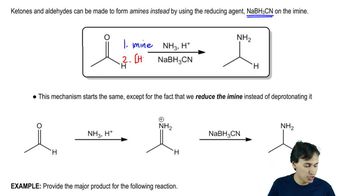
Reductive Amination

Stereochemistry

Stereochemistry refers to the spatial arrangement of atoms in molecules and how this affects their chemical behavior. The conversion of 3-bromocyclohexanol to the target diol involves careful consideration of stereochemical outcomes, particularly if chiral centers are formed or altered. Understanding stereochemical principles is vital for predicting the configuration of the final product and ensuring the correct diol is synthesized.
추천 영상:
가이드 코스
1:38
Polymer Stereochemistry Concept 1
관련 실천
교과서 질문

Propylene oxide is a chiral molecule. Hydrolysis of propylene oxide gives propylene glycol, another chiral molecule.

(a) Draw the enantiomers of propylene oxide.

(b) Propose a mechanism for the acid-catalyzed hydrolysis of pure (R)-propylene oxide.

1199
views
교과서 질문

Show how you would synthesize the following ethers in good yield from the indicated starting materials and any additional reagents needed.

(d) 1-methoxydecane from a decene

526
views
교과서 질문

There are two different ways of making 2-ethoxyoctane from octan-2-ol using the Williamson ether synthesis. When pure (–)-octan-2-ol of specific rotation -8.24° is treated with sodium metal and then ethyl iodide, the product is 2-ethoxyoctane with a specific rotation of -15.6°. When pure (–)-octan-2-ol is treated with tosyl chloride and pyridine and then with sodium ethoxide, the product is also 2-ethoxyoctane. Predict the rotation of the 2-ethoxyoctane made using the tosylation/sodium ethoxide procedure, and propose a detailed mechanism to support your prediction.

1080
views
교과서 질문

An acid-catalyzed reaction was carried out using methyl cellosolve (2-methoxyethanol) as the solvent. When the 2-methoxyethanol was redistilled, a higher-boiling fraction (bp 162°C) was also recovered. The mass spectrum of this fraction showed the molecular weight to be 134. The IR and NMR spectra are shown here. Determine the structure of this compound, and propose a mechanism for its formation.

<IMAGE>

1388
views
교과서 질문

Show how you would synthesize the following ethers in good yield from the indicated starting materials and any additional reagents needed.

(f) trans-2,3-epoxyoctane from octan-2-ol

537
views
교과서 질문

Show how you would synthesize the following ethers in good yield from the indicated starting materials and any additional reagents needed.

(e) 1-ethoxy-1-methylcyclohexane from 2-methylcyclohexanol

555
views