Ch. 14 - Ethers, Epoxides, and Thioethers
Wade - Organic Chemistry 9th Edition
Wade9th EditionOrganic ChemistryISBN: 9780135213728당신이 사용하는 게 아니라요?교과서 변경
14장, 문제 45e

Show how you would synthesize the following ethers in good yield from the indicated starting materials and any additional reagents needed.
(e) 1-ethoxy-1-methylcyclohexane from 2-methylcyclohexanol

검증된 단계별 안내
1
Step 1: Begin with the starting material, 2-methylcyclohexanol. Recognize that the hydroxyl group (-OH) on the cyclohexanol must be converted into a good leaving group to facilitate the ether synthesis.
Step 2: Convert the hydroxyl group into a better leaving group by reacting 2-methylcyclohexanol with a reagent like p-toluenesulfonyl chloride (TsCl) in the presence of a base such as pyridine. This will form the tosylate derivative, 2-methylcyclohexyl tosylate.
Step 3: Prepare the ethoxide nucleophile by reacting ethanol (C₂H₅OH) with a strong base such as sodium hydride (NaH) or sodium metal (Na). This generates sodium ethoxide (C₂H₅O⁻), a strong nucleophile.
Step 4: Perform an SN2 reaction by reacting the 2-methylcyclohexyl tosylate with sodium ethoxide. The ethoxide ion will attack the carbon bonded to the tosylate group, displacing the tosylate and forming 1-ethoxy-1-methylcyclohexane.
Step 5: Purify the product using standard organic chemistry techniques such as distillation or chromatography to isolate 1-ethoxy-1-methylcyclohexane in good yield.

비슷한 문제에 대한 검증된 영상 답변:

이 영상 해법은 위 문제에 도움이 된다고 튜터들이 추천한 것입니다.
영상 길이:
3m
도움이 되었나요?

주요 개념

질문에 올바르게 답하기 위해 반드시 이해해야 하는 핵심 개념들은 다음과 같습니다.

Ethers and Their Synthesis

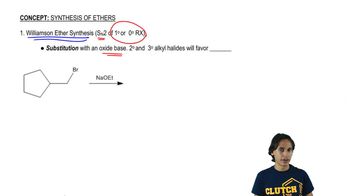
Ethers are organic compounds characterized by an oxygen atom bonded to two alkyl or aryl groups. They can be synthesized through various methods, including the Williamson ether synthesis, which involves the reaction of an alkoxide ion with a primary alkyl halide. Understanding the reactivity and properties of ethers is crucial for designing effective synthetic routes.
추천 영상:
가이드 코스
03:50
The Mechanism of Williamson Ether Synthesis.

Alcohols as Reactants

Alcohols, such as 2-methylcyclohexanol, serve as important starting materials in organic synthesis. They can undergo various transformations, including dehydration to form alkenes or nucleophilic substitution to produce ethers. Recognizing the functional groups and their reactivity patterns is essential for planning the synthesis of target compounds.
추천 영상:
가이드 코스
01:01
How to name alcohols

Nucleophilic Substitution Reactions

Nucleophilic substitution reactions, particularly SN2 mechanisms, are fundamental in organic chemistry for forming new bonds. In the context of ether synthesis, a nucleophile (like an alkoxide) attacks an electrophilic carbon in an alkyl halide, leading to the formation of the ether. Understanding the conditions that favor SN2 reactions, such as sterics and solvent effects, is vital for achieving good yields.
추천 영상:
가이드 코스
01:47
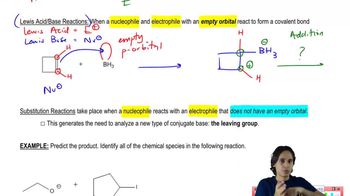
Nucleophiles and Electrophiles can react in Substitution Reactions.
관련 실천
교과서 질문

Show how you would synthesize the following ethers in good yield from the indicated starting materials and any additional reagents needed.

(d) 1-methoxydecane from a decene

526
views

교과서 질문

There are two different ways of making 2-ethoxyoctane from octan-2-ol using the Williamson ether synthesis. When pure (–)-octan-2-ol of specific rotation -8.24° is treated with sodium metal and then ethyl iodide, the product is 2-ethoxyoctane with a specific rotation of -15.6°. When pure (–)-octan-2-ol is treated with tosyl chloride and pyridine and then with sodium ethoxide, the product is also 2-ethoxyoctane. Predict the rotation of the 2-ethoxyoctane made using the tosylation/sodium ethoxide procedure, and propose a detailed mechanism to support your prediction.

1080
views
교과서 질문

Show how you would synthesize the following ethers in good yield from the indicated starting materials and any additional reagents needed.

(c) 2-ethoxyoctane from an octene

548
views
교과서 질문

Show how you would synthesize the following ethers in good yield from the indicated starting materials and any additional reagents needed.

(f) trans-2,3-epoxyoctane from octan-2-ol

537
views
교과서 질문

Show how you would synthesize the following ethers in good yield from the indicated starting materials and any additional reagents needed.

(b) n-butyl phenyl ether from phenol and butan-1-ol

628
views
교과서 질문

Show how you would convert 3-bromocyclohexanol to the following diol. You may use any additional reagents you need.

1173
views