Ch. 16 - Aromatic Compounds
Wade - Organic Chemistry 9th Edition
Wade9th EditionOrganic ChemistryISBN: 9780135213728당신이 사용하는 게 아니라요?교과서 변경
16장, 문제 17

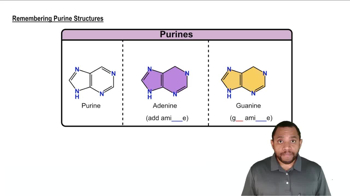
Show which of the nitrogen atoms in purine are basic, and which one is not basic. For the nonbasic nitrogen, explain why its nonbonding electrons are not easily available to become protonated.

검증된 단계별 안내
1
Step 1: Begin by identifying the structure of purine. Purine is a heterocyclic aromatic compound with a fused ring system consisting of a pyrimidine ring and an imidazole ring. It contains four nitrogen atoms in total.
Step 2: Analyze the electronic environment of each nitrogen atom. In aromatic systems, the basicity of nitrogen atoms depends on whether their lone pairs are involved in the aromatic π-system or are free to accept a proton.
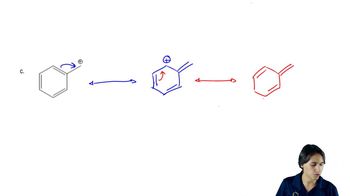
Step 3: For the nitrogen atoms in purine, determine their roles in the aromatic system. Use resonance structures to see if the lone pairs of electrons on the nitrogen atoms are delocalized into the π-system. Nitrogen atoms with delocalized lone pairs are not basic because their electrons are not readily available for protonation.
Step 4: Identify the basic nitrogen atoms. Nitrogen atoms whose lone pairs are not involved in the aromatic π-system are basic because their electrons are free to accept a proton. These nitrogen atoms can act as proton acceptors.
Step 5: Explain why the nonbasic nitrogen atom is not basic. The lone pair of electrons on this nitrogen is delocalized into the aromatic π-system, contributing to the stability of the aromatic ring. Because these electrons are part of the conjugated π-system, they are not easily available for protonation, making the nitrogen atom nonbasic.

비슷한 문제에 대한 검증된 영상 답변:

이 영상 해법은 위 문제에 도움이 된다고 튜터들이 추천한 것입니다.
영상 길이:
5m
도움이 되었나요?

주요 개념

질문에 올바르게 답하기 위해 반드시 이해해야 하는 핵심 개념들은 다음과 같습니다.

Basicity of Nitrogen Atoms

Basicity in organic chemistry refers to the ability of a nitrogen atom to accept a proton (H+). Nitrogen atoms in purine can vary in their basicity depending on their electronic environment and hybridization. Typically, nitrogen atoms with a lone pair of electrons in a suitable orbital can act as bases, while those involved in aromatic systems or with electron-withdrawing groups may be less basic.
추천 영상:
1:45
Nitrogenous Bases Concept 3

Structure of Purine

Purine is a bicyclic compound consisting of a fused imidazole and pyrimidine ring. It contains four nitrogen atoms, each positioned differently within the rings. Understanding the spatial arrangement and hybridization of these nitrogen atoms is crucial for determining which are basic and which are not, as their electronic properties are influenced by their connectivity and the overall molecular structure.
추천 영상:
가이드 코스
03:04
Drawing Resonance Structures

Nonbonding Electrons and Protonation

Nonbonding electrons are lone pairs that are not involved in covalent bonding. For a nitrogen atom to be basic, its nonbonding electrons must be available to accept a proton. In the case of the nonbasic nitrogen in purine, steric hindrance or resonance stabilization can delocalize these electrons, making them less available for protonation, thus reducing the atom's basicity.
추천 영상:
가이드 코스
03:54
The 18 and 16 Electron Rule