Show the product of the Diels–Alder dimerization of cyclobutadiene. (This reaction is similar to the dimerization of cyclopentadiene, discussed in Section 15-11.)
Ch. 16 - Aromatic Compounds
16장, 문제 2c
Using the information in Figure 16-2, calculate the values of ∆H° for the following reactions:
(c) 
검증된 단계별 안내1
Step 1: Identify the reaction type. The given reaction is a hydrogenation reaction where one double bond in cyclohexene is reduced to form cyclohexane using hydrogen gas and a catalyst.
Step 2: Understand the enthalpy change (∆H°) for hydrogenation reactions. Hydrogenation reactions typically release energy, and the enthalpy change is negative. The value of ∆H° for hydrogenation of one double bond can be found in Figure 16-2 or similar reference data.
Step 3: Locate the ∆H° value for the hydrogenation of a single double bond in the reference figure. This value is specific to the reaction of converting cyclohexene to cyclohexane.
Step 4: Write the balanced chemical equation for the reaction: . This equation represents the addition of hydrogen to cyclohexene.
Step 5: Use the ∆H° value from the reference figure to calculate the enthalpy change for the reaction. Ensure the units are consistent (e.g., kJ/mol) and interpret the negative sign as energy released during the reaction.

비슷한 문제에 대한 검증된 영상 답변:
이 영상 해법은 위 문제에 도움이 된다고 튜터들이 추천한 것입니다.
영상 길이:
4m주요 개념
질문에 올바르게 답하기 위해 반드시 이해해야 하는 핵심 개념들은 다음과 같습니다.
Enthalpy Change (∆H°)
Enthalpy change (∆H°) is a measure of the heat content of a system at constant pressure. It indicates whether a reaction is exothermic (releases heat, ∆H° < 0) or endothermic (absorbs heat, ∆H° > 0). Calculating ∆H° for a reaction involves using standard enthalpies of formation for the reactants and products, allowing chemists to predict energy changes during chemical transformations.
추천 영상:
Calculating Enthalpies
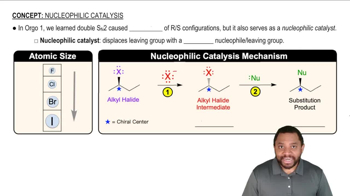
Catalysis
Catalysis refers to the process of increasing the rate of a chemical reaction by adding a substance known as a catalyst. In the reaction shown, a catalyst facilitates the hydrogenation of benzene to cyclohexane, lowering the activation energy required for the reaction to proceed. Catalysts are not consumed in the reaction, allowing them to be used repeatedly in multiple reaction cycles.
추천 영상:
가이드 코스
Nucleophilic Catalysis Concept 1
Hydrogenation
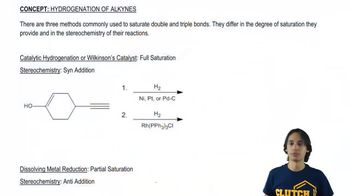
Hydrogenation is a chemical reaction that involves the addition of hydrogen (H₂) to an unsaturated compound, such as an alkene or an aromatic compound. In this case, benzene, an aromatic compound, reacts with hydrogen in the presence of a catalyst to form cyclohexane, a saturated compound. This process is significant in organic chemistry for converting unsaturated hydrocarbons into more stable saturated forms.
추천 영상:
The definition of hydrogenation.
관련 실천
교과서 질문
1054
views
교과서 질문
a. Draw the resonance forms of benzene, cyclobutadiene, and cyclooctatetraene, showing all the carbon and hydrogen atoms.
b. Assuming that these molecules are all planar, show how the p orbitals on the sp2 hybrid carbon atoms form continuous rings of overlapping orbitals above and below the plane of the carbon atoms.
1002
views
교과서 질문
Using the information in Figure 16-2, calculate the values of ∆H° for the following reactions:
(b)
578
views
교과서 질문
Does the MO energy diagram of cyclooctatetraene (Figure 16-8) appear to be a particularly stable or unstable configuration? Explain.
1970
views
1
rank
교과서 질문
Using the information in Figure 16-2, calculate the values of ∆H° for the following reactions:
(a)
721
views