Ch. 17 - Reactions of Aromatic Compounds
Wade - Organic Chemistry 9th Edition
Wade9th EditionOrganic ChemistryISBN: 9780135213728당신이 사용하는 게 아니라요?교과서 변경
17장, 문제 22

Propose a mechanism that shows why p-chlorotoluene reacts with sodium hydroxide at 350 °C to give a mixture of p-cresol and m-cresol.

검증된 단계별 안내
1
Step 1: Recognize that the reaction involves nucleophilic aromatic substitution (NAS). This type of reaction occurs when an electron-withdrawing group (such as a halogen) is present on an aromatic ring, making the ring susceptible to attack by a nucleophile (in this case, hydroxide ion, OH⁻).
Step 2: Identify the electron-withdrawing group and its position. In p-chlorotoluene, the chlorine atom is the electron-withdrawing group, and it is located at the para position relative to the methyl group. The methyl group is electron-donating, which slightly affects the reactivity of the ring.
Step 3: Explain the role of high temperature (350 °C). The elevated temperature provides the energy required for the reaction to proceed via the benzyne intermediate mechanism, which is common in NAS reactions under harsh conditions. This mechanism involves elimination followed by addition.
Step 4: Describe the formation of the benzyne intermediate. The hydroxide ion first abstracts a proton from the position ortho to the chlorine atom, leading to the elimination of the chlorine atom and the formation of a triple bond (benzyne intermediate) in the aromatic ring. This intermediate is highly reactive.
Step 5: Explain the nucleophilic attack on the benzyne intermediate. The hydroxide ion can attack either end of the triple bond in the benzyne intermediate, leading to the formation of two possible products: p-cresol (if the attack occurs at the original para position) and m-cresol (if the attack occurs at the meta position). This accounts for the mixture of products observed in the reaction.

비슷한 문제에 대한 검증된 영상 답변:

이 영상 해법은 위 문제에 도움이 된다고 튜터들이 추천한 것입니다.
영상 길이:
9m

주요 개념

질문에 올바르게 답하기 위해 반드시 이해해야 하는 핵심 개념들은 다음과 같습니다.

Nucleophilic Aromatic Substitution

Nucleophilic aromatic substitution (NAS) is a reaction mechanism where a nucleophile replaces a leaving group on an aromatic ring. In the case of p-chlorotoluene, the chlorine atom is a good leaving group, allowing sodium hydroxide (a strong nucleophile) to attack the aromatic ring. This mechanism is crucial for understanding how the reaction proceeds to form p-cresol and m-cresol.
추천 영상:
01:47
Nucleophiles and Electrophiles can react in Substitution Reactions.

Regioselectivity

Regioselectivity refers to the preference of a chemical reaction to yield one structural isomer over others. In the reaction of p-chlorotoluene with sodium hydroxide, the formation of p-cresol and m-cresol illustrates regioselectivity, as the nucleophile can attack at different positions on the aromatic ring. The electronic effects and steric factors influence which isomer is predominantly formed.
추천 영상:
05:09
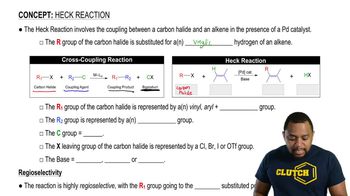
Heck Reaction

Thermal Conditions and Reaction Kinetics

The temperature of a reaction can significantly affect its kinetics and the products formed. At elevated temperatures, such as 350 °C, the reaction may favor certain pathways or mechanisms, enhancing the likelihood of NAS occurring. Understanding how temperature influences reaction rates and equilibria is essential for predicting the outcome of the reaction between p-chlorotoluene and sodium hydroxide.
추천 영상:
06:36
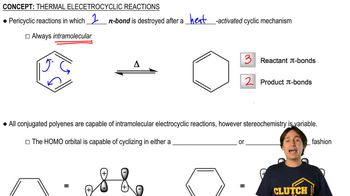
MO Theory of Thermal Electrocyclics