Propose a mechanism that shows why p-chlorotoluene reacts with sodium hydroxide at 350 °C to give a mixture of p-cresol and m-cresol.
Ch. 17 - Reactions of Aromatic Compounds
17장, 문제 20f
Show how you would use the Friedel–Crafts acylation, Clemmensen reduction, and/or Gatterman–Koch synthesis to prepare the following compounds:
f. 1-phenyl-2,2-dimethylpropane
검증된 단계별 안내1
Step 1: Begin with benzene as the starting material. To introduce the acyl group, use the Friedel–Crafts acylation reaction. React benzene with isobutyryl chloride (CH3C(O)CH(CH3)2) in the presence of a Lewis acid catalyst such as AlCl3. This will yield 1-phenyl-2-methylpropan-1-one (a ketone).
Step 2: The product from Step 1 contains a ketone group. To reduce the ketone to a methylene group (-CH2-), use the Clemmensen reduction. Treat the ketone with zinc amalgam (Zn(Hg)) and concentrated hydrochloric acid (HCl). This will convert the ketone into 1-phenyl-2,2-dimethylpropane.
Step 3: Verify the structure of the final product to ensure it matches 1-phenyl-2,2-dimethylpropane. The benzene ring should be attached to a carbon atom that is bonded to two methyl groups and one hydrogen atom.
Step 4: Consider any potential side reactions or limitations of the Friedel–Crafts acylation and Clemmensen reduction. For example, ensure that the starting materials and reagents are compatible and that the reaction conditions are controlled to avoid over-reduction or rearrangements.
Step 5: If needed, purify the final product using techniques such as distillation or recrystallization to isolate 1-phenyl-2,2-dimethylpropane in its pure form.

비슷한 문제에 대한 검증된 영상 답변:
이 영상 해법은 위 문제에 도움이 된다고 튜터들이 추천한 것입니다.
영상 길이:
3m주요 개념
질문에 올바르게 답하기 위해 반드시 이해해야 하는 핵심 개념들은 다음과 같습니다.
Friedel–Crafts Acylation
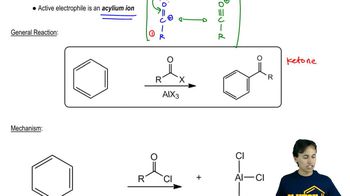
Friedel–Crafts acylation is an electrophilic aromatic substitution reaction that introduces an acyl group into an aromatic ring. This reaction typically uses an acyl chloride and a Lewis acid catalyst, such as aluminum chloride, to form a ketone. The acyl group enhances the reactivity of the aromatic ring, allowing for further functionalization, which is crucial for synthesizing complex organic molecules.
추천 영상:
Friedel-Crafts Acylation
Clemmensen Reduction
The Clemmensen reduction is a chemical reaction that reduces carbonyl groups (aldehydes and ketones) to alkanes using zinc amalgam and hydrochloric acid. This method is particularly useful for converting acylated aromatic compounds into their corresponding alkylated derivatives, facilitating the synthesis of hydrocarbons like 1-phenyl-2,2-dimethylpropane from acylated precursors.
추천 영상:
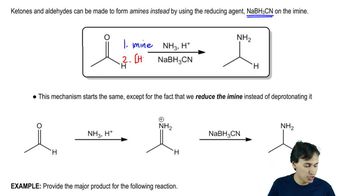
Reductive Amination
Gatterman–Koch Synthesis
The Gatterman–Koch synthesis is a method for synthesizing aromatic aldehydes through the formylation of aromatic compounds using carbon monoxide and hydrochloric acid in the presence of a Lewis acid catalyst. This reaction is significant for introducing functional groups into aromatic systems, which can be further manipulated to create complex structures, such as the desired alkane in the question.
추천 영상:
가이드 코스
Synthesis of Amino Acids: Strecker Synthesis Example 1
관련 실천
교과서 질문
1486
views
교과서 질문
Show how you would use the Friedel–Crafts acylation, Clemmensen reduction, and/or Gatterman–Koch synthesis to prepare the following compounds:
b.
1361
views
교과서 질문
Show how you would use the Friedel–Crafts acylation, Clemmensen reduction, and/or Gatterman–Koch synthesis to prepare the following compounds:
c.
1120
views
교과서 질문
Show how you would use the Friedel–Crafts acylation, Clemmensen reduction, and/or Gatterman–Koch synthesis to prepare the following compounds:
a.
1330
views
교과서 질문
Show how you would use the Friedel–Crafts acylation, Clemmensen reduction, and/or Gatterman–Koch synthesis to prepare the following compounds:
g. n-butylbenzene
1119
views
교과서 질문
Show how you would use the Friedel–Crafts acylation, Clemmensen reduction, and/or Gatterman–Koch synthesis to prepare the following compounds:
h.
733
views