

Ch. 18 - Ketones and Aldehydes
Wade - Organic Chemistry 9th Edition
Wade9th EditionOrganic ChemistryISBN: 9780135213728당신이 사용하는 게 아니라요?교과서 변경
18장, 문제 28b

Propose a mechanism for the acid-catalyzed hydrolysis of cyclohexanone ethylene acetal.

검증된 단계별 안내
1
Identify the functional group in cyclohexanone ethylene acetal. The acetal group consists of two ether linkages (-OR) attached to the same carbon atom. Acetals are stable under basic conditions but can be hydrolyzed in the presence of an acid.
Protonate one of the ether oxygen atoms using the acid catalyst (e.g., H⁺). This step increases the electrophilicity of the carbon atom attached to the oxygen, making it more susceptible to nucleophilic attack.
Facilitate the departure of the first leaving group (an alcohol molecule, CH₂OH) by breaking the C-O bond. This step forms a resonance-stabilized oxonium ion intermediate.
Add water (H₂O) as a nucleophile to the oxonium ion intermediate. The water molecule attacks the electrophilic carbon, forming a new C-O bond and generating a protonated diol intermediate.
Deprotonate the diol intermediate to yield the final product, cyclohexanone, and regenerate the acid catalyst. This completes the acid-catalyzed hydrolysis mechanism.

비슷한 문제에 대한 검증된 영상 답변:

이 영상 해법은 위 문제에 도움이 된다고 튜터들이 추천한 것입니다.
영상 길이:
9m

주요 개념

질문에 올바르게 답하기 위해 반드시 이해해야 하는 핵심 개념들은 다음과 같습니다.

Acid-Catalyzed Hydrolysis

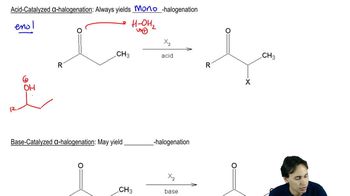
Acid-catalyzed hydrolysis is a reaction where an acetal is converted back to its corresponding carbonyl compound and alcohol in the presence of an acid. The acid protonates the acetal oxygen, making it more susceptible to nucleophilic attack by water. This process typically involves the formation of a carbocation intermediate, which is stabilized by the surrounding solvent and leads to the cleavage of the acetal bond.
추천 영상:
03:09
Acid Catalyzed

Acetals and Their Formation

Acetals are organic compounds formed from the reaction of an aldehyde or ketone with an alcohol, resulting in a structure where two alkoxy groups are attached to the same carbon atom. In the case of cyclohexanone ethylene acetal, cyclohexanone reacts with ethylene glycol to form the acetal. Understanding the structure and stability of acetals is crucial for predicting their reactivity in hydrolysis reactions.
추천 영상:
04:29
Acetal Protecting Group

Mechanism of Nucleophilic Substitution

The mechanism of nucleophilic substitution involves the attack of a nucleophile on an electrophilic carbon, leading to the displacement of a leaving group. In the context of acid-catalyzed hydrolysis, water acts as the nucleophile that attacks the carbocation formed after the protonation of the acetal. This mechanism is essential for understanding how the acetal bond is broken and how the original carbonyl compound is regenerated.
추천 영상:
01:47
Nucleophiles and Electrophiles can react in Substitution Reactions.