Ch. 18 - Ketones and Aldehydes
Wade - Organic Chemistry 9th Edition
Wade9th EditionOrganic ChemistryISBN: 9780135213728당신이 사용하는 게 아니라요?교과서 변경
18장, 문제 49a

For each compound,
1. name the functional group.
2. show what compound(s) result from complete hydrolysis.
(a)

검증된 단계별 안내
1
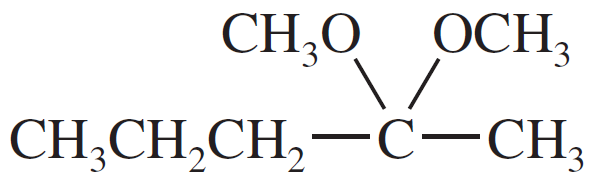
Step 1: Identify the functional group in the compound. The structure contains two methoxy groups (-OCH₃) attached to a central carbon atom. This indicates the presence of an acetal functional group.
Step 2: Understand the concept of hydrolysis. Hydrolysis involves breaking chemical bonds using water, often catalyzed by an acid or base. Acetals are hydrolyzed under acidic conditions to yield an aldehyde or ketone and alcohols.
Step 3: Analyze the structure to determine the products of hydrolysis. The central carbon atom is bonded to two methoxy groups and two methyl groups (-CH₃). This suggests that the acetal will hydrolyze to form acetone (a ketone) and methanol (an alcohol).
Step 4: Write the chemical equation for the hydrolysis reaction. The acetal reacts with water under acidic conditions to produce acetone (CH₃COCH₃) and two molecules of methanol (CH₃OH).
Step 5: Summarize the results. The functional group is an acetal, and the products of complete hydrolysis are acetone and methanol.

비슷한 문제에 대한 검증된 영상 답변:

이 영상 해법은 위 문제에 도움이 된다고 튜터들이 추천한 것입니다.
영상 길이:
9m
도움이 되었나요?

주요 개념

질문에 올바르게 답하기 위해 반드시 이해해야 하는 핵심 개념들은 다음과 같습니다.

Functional Groups

Functional groups are specific groups of atoms within molecules that are responsible for the characteristic chemical reactions of those molecules. Common functional groups include hydroxyl (-OH), carbonyl (C=O), and amine (-NH2). Identifying the functional group in a compound is crucial for predicting its reactivity and properties.
추천 영상:
02:36
Identifying Functional Groups

Hydrolysis

Hydrolysis is a chemical reaction in which water is used to break down a compound. In organic chemistry, hydrolysis often involves the cleavage of bonds in larger molecules, resulting in smaller molecules or functional groups. Complete hydrolysis of certain compounds can yield alcohols, acids, or other functional groups, depending on the structure of the original compound.
추천 영상:
가이드 코스
1:00
Hydrolysis of Thioesters Concept 2

Imines and Enamines

Imines and enamines are nitrogen-containing functional groups derived from carbonyl compounds. Imines are formed by the reaction of aldehydes or ketones with amines, while enamines are formed from the reaction of imines with alkenes. Understanding these structures is essential for predicting the products of hydrolysis and other reactions involving these compounds.
추천 영상:
06:25
Enamine Mechanism