Ch. 18 - Ketones and Aldehydes
Wade - Organic Chemistry 9th Edition
Wade9th EditionOrganic ChemistryISBN: 9780135213728당신이 사용하는 게 아니라요?교과서 변경
18장, 문제 47h

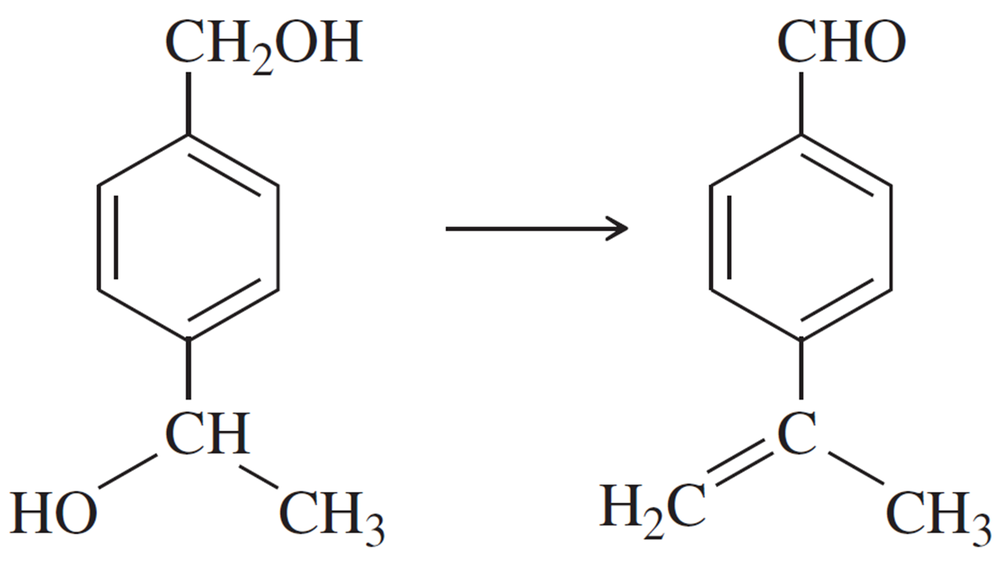
Show how you would accomplish the following synthetic conversions efficiently and in good yield. You may use any necessary additional reagents and solvents.
(h)

검증된 단계별 안내
1
Step 1: Analyze the transformation. The starting material is a benzyl alcohol derivative with a hydroxyl group and a methyl group on the aromatic ring. The product is an aldehyde with a vinyl group and a methyl group on the aromatic ring. This suggests oxidation of the benzyl alcohol to an aldehyde and subsequent elimination to form the vinyl group.
Step 2: Perform oxidation of the benzyl alcohol group (-CH2OH) to an aldehyde (-CHO). Use a mild oxidizing agent such as PCC (Pyridinium Chlorochromate) or DMP (Dess-Martin Periodinane) to avoid overoxidation to a carboxylic acid.
Step 3: Introduce conditions for elimination to form the vinyl group. The hydroxyl group on the aromatic ring can be activated for elimination by converting it into a good leaving group, such as a tosylate (-OTs) using p-toluenesulfonyl chloride and a base like pyridine.
Step 4: Carry out the elimination reaction. Use a strong base such as potassium tert-butoxide (KOtBu) to promote elimination of the tosylate group, forming the vinyl group (-CH=CH2) on the aromatic ring.
Step 5: Verify the stereochemistry and ensure the reaction proceeds efficiently. Adjust reaction conditions (temperature, solvent) to optimize yield and minimize side reactions. Purify the product using techniques like recrystallization or column chromatography.

비슷한 문제에 대한 검증된 영상 답변:

이 영상 해법은 위 문제에 도움이 된다고 튜터들이 추천한 것입니다.
영상 길이:
8m

주요 개념

질문에 올바르게 답하기 위해 반드시 이해해야 하는 핵심 개념들은 다음과 같습니다.

Synthetic Pathways

Synthetic pathways refer to the series of chemical reactions and transformations that convert starting materials into desired products. Understanding these pathways is crucial for planning efficient syntheses, as it involves selecting appropriate reagents, conditions, and reaction mechanisms to achieve high yields and minimize by-products.
추천 영상:
가이드 코스
2:13
Energy Production In Biochemical Pathways Concept 1

Reagents and Solvents

Reagents are substances used to bring about a chemical reaction, while solvents are the mediums in which reactions occur. Choosing the right reagents and solvents is essential for optimizing reaction conditions, influencing factors such as solubility, reactivity, and selectivity, which ultimately affect the yield and efficiency of the synthetic conversion.
추천 영상:
01:16
Identification of polarity in solvents

Reaction Mechanisms

Reaction mechanisms describe the step-by-step sequence of elementary reactions that occur during a chemical transformation. A thorough understanding of these mechanisms allows chemists to predict the outcomes of reactions, identify potential side reactions, and design strategies to enhance product formation, which is vital for achieving good yields in synthetic chemistry.
추천 영상:
02:16
Heck Reaction Mechanism