Ch. 18 - Ketones and Aldehydes
Wade - Organic Chemistry 9th Edition
Wade9th EditionOrganic ChemistryISBN: 9780135213728당신이 사용하는 게 아니라요?교과서 변경
18장, 문제 54c

Predict the products formed when cyclohexanecarbaldehyde reacts with the following reagents.
(c) semicarbazide and weak acid

검증된 단계별 안내
1
Identify the functional group in cyclohexanecarbaldehyde. The molecule contains an aldehyde group (-CHO) attached to a cyclohexane ring.
Understand the role of semicarbazide in the reaction. Semicarbazide is a derivative of hydrazine (NH2-NH2) and reacts with aldehydes or ketones to form semicarbazones. This reaction is a nucleophilic addition-elimination process.
Recognize the role of the weak acid. The weak acid provides a mildly acidic environment, which helps to protonate the carbonyl oxygen of the aldehyde, making the carbonyl carbon more electrophilic and susceptible to nucleophilic attack by semicarbazide.
Write the reaction mechanism: (1) The lone pair on the nitrogen atom of semicarbazide attacks the electrophilic carbonyl carbon of the aldehyde, forming a tetrahedral intermediate. (2) Proton transfer occurs, facilitated by the weak acid, leading to the elimination of water and the formation of a double bond between the carbon and nitrogen.
Conclude that the product of the reaction is a semicarbazone, specifically cyclohexanecarbaldehyde semicarbazone, where the aldehyde group has been converted into a C=N-NH-CO-NH2 functional group.

비슷한 문제에 대한 검증된 영상 답변:

이 영상 해법은 위 문제에 도움이 된다고 튜터들이 추천한 것입니다.
영상 길이:
3m
도움이 되었나요?

주요 개념

질문에 올바르게 답하기 위해 반드시 이해해야 하는 핵심 개념들은 다음과 같습니다.

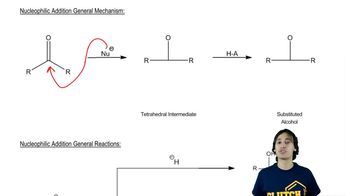
Nucleophilic Addition

Nucleophilic addition is a fundamental reaction mechanism in organic chemistry where a nucleophile attacks an electrophilic carbon atom, typically found in carbonyl groups. In the case of cyclohexanecarbaldehyde, the carbonyl carbon is susceptible to attack by nucleophiles, such as semicarbazide, leading to the formation of a new bond and the eventual production of a corresponding addition product.
추천 영상:
08:27
Nucleophilic Addition

Formation of Hydrazones and Semicarbazones

Semicarbazide reacts with aldehydes and ketones to form semicarbazones, which are characterized by the presence of a C=N bond. This reaction is significant in organic synthesis and analytical chemistry, as semicarbazones can be used to identify and characterize carbonyl compounds. The reaction typically occurs under mild acidic conditions, facilitating the nucleophilic attack on the carbonyl carbon.
추천 영상:
02:26
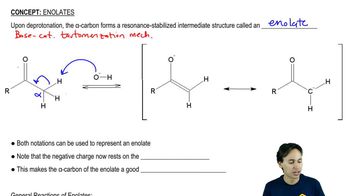
Formation of Enolates

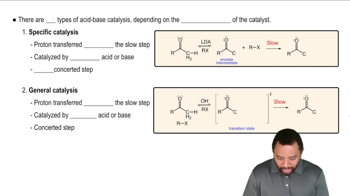
Acid-Base Catalysis

Acid-base catalysis involves the use of an acid or a base to enhance the rate of a chemical reaction. In the context of the reaction between cyclohexanecarbaldehyde and semicarbazide, a weak acid can help protonate the carbonyl oxygen, increasing the electrophilicity of the carbonyl carbon. This makes it more susceptible to nucleophilic attack, thereby promoting the formation of the semicarbazone product.
추천 영상:
가이드 코스
2:50
Acid-Base Catalysis Concept 3