Ch. 18 - Ketones and Aldehydes
Wade - Organic Chemistry 9th Edition
Wade9th EditionOrganic ChemistryISBN: 9780135213728당신이 사용하는 게 아니라요?교과서 변경
18장, 문제 53g

Predict the products formed when cyclohexanone reacts with the following reagents.
g. Tollens reagent

검증된 단계별 안내
1
Step 1: Recognize the functional group in cyclohexanone. Cyclohexanone is a ketone, characterized by a carbonyl group (C=O) bonded to two alkyl groups.
Step 2: Understand the nature of Tollens reagent. Tollens reagent is an aqueous solution of silver nitrate (AgNO₃) and ammonia (NH₃), which is used to test for aldehydes. It oxidizes aldehydes to carboxylic acids and reduces Ag⁺ ions to metallic silver (Ag).
Step 3: Determine the reactivity of ketones with Tollens reagent. Ketones, unlike aldehydes, generally do not react with Tollens reagent because they cannot be oxidized under these conditions. The carbonyl group in ketones is less reactive toward oxidation due to the absence of a hydrogen atom directly bonded to the carbonyl carbon.
Step 4: Predict the outcome of the reaction. Since cyclohexanone is a ketone, it will not react with Tollens reagent, and no oxidation or reduction will occur. The solution will remain unchanged, and no silver mirror will form.
Step 5: Summarize the result. Cyclohexanone does not produce any products when treated with Tollens reagent because ketones are resistant to oxidation by this reagent.

비슷한 문제에 대한 검증된 영상 답변:

이 영상 해법은 위 문제에 도움이 된다고 튜터들이 추천한 것입니다.
영상 길이:
1m
도움이 되었나요?

주요 개념

질문에 올바르게 답하기 위해 반드시 이해해야 하는 핵심 개념들은 다음과 같습니다.

Tollens' Reagent

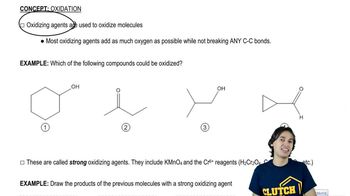
Tollens' reagent is a solution of silver nitrate in ammonia, commonly used to test for aldehydes. It contains the complex ion [Ag(NH3)2]+, which oxidizes aldehydes to carboxylic acids while reducing silver ions to metallic silver. In the case of cyclohexanone, which is a ketone, it does not react with Tollens' reagent, as ketones are generally not oxidized by this reagent.
추천 영상:
01:52
Reagents

Oxidation-Reduction Reactions

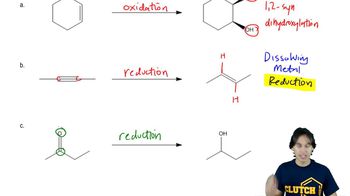
Oxidation-reduction (redox) reactions involve the transfer of electrons between substances, leading to changes in oxidation states. In organic chemistry, oxidation often refers to the addition of oxygen or the removal of hydrogen, while reduction is the opposite. Understanding these concepts is crucial for predicting the outcomes of reactions involving reagents like Tollens' reagent, which specifically oxidizes aldehydes but not ketones.
추천 영상:
00:54
Distinguishing between Oxidation and Reduction

Reactivity of Ketones vs. Aldehydes

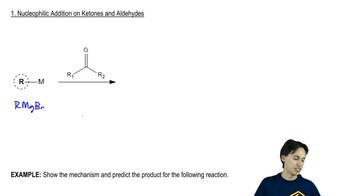
Ketones and aldehydes are both carbonyl compounds, but they differ in reactivity due to their structural features. Aldehydes have at least one hydrogen atom attached to the carbonyl carbon, making them more susceptible to oxidation. In contrast, ketones, such as cyclohexanone, have two alkyl groups attached to the carbonyl carbon, which makes them less reactive towards oxidizing agents like Tollens' reagent.
추천 영상:
03:57
Nucleophilic Addition on Ketones and Aldehydes