Ch. 18 - Ketones and Aldehydes
Wade - Organic Chemistry 9th Edition
Wade9th EditionOrganic ChemistryISBN: 9780135213728당신이 사용하는 게 아니라요?교과서 변경
18장, 문제 53h

Predict the products formed when cyclohexanone reacts with the following reagents.
(h) sodium acetylide, then mild H3O+

검증된 단계별 안내
1
Identify the functional group in cyclohexanone. Cyclohexanone is a cyclic ketone, which contains a carbonyl group (C=O) as its functional group.
Understand the reactivity of sodium acetylide (NaC≡CH). Sodium acetylide is a strong nucleophile due to the negatively charged carbon in the acetylide ion (C≡C⁻). It can attack electrophilic centers, such as the carbonyl carbon in cyclohexanone.
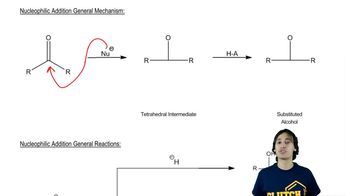
Propose the nucleophilic addition mechanism. The acetylide ion will attack the electrophilic carbonyl carbon of cyclohexanone, breaking the π bond of the carbonyl group and forming a tetrahedral alkoxide intermediate.
Account for the role of mild H3O⁺. The alkoxide intermediate formed in the previous step will be protonated by the mild acid (H3O⁺), resulting in the formation of a hydroxy group (-OH) at the former carbonyl carbon.
Predict the final product. The reaction will yield a compound where the acetylide group (C≡CH) is attached to the former carbonyl carbon, and the oxygen atom is converted into a hydroxyl group (-OH), forming a propargylic alcohol.

비슷한 문제에 대한 검증된 영상 답변:

이 영상 해법은 위 문제에 도움이 된다고 튜터들이 추천한 것입니다.
영상 길이:
1m
도움이 되었나요?

주요 개념

질문에 올바르게 답하기 위해 반드시 이해해야 하는 핵심 개념들은 다음과 같습니다.

Nucleophilic Addition

Nucleophilic addition is a fundamental reaction mechanism in organic chemistry where a nucleophile attacks an electrophilic carbon atom, typically in a carbonyl group. In the case of cyclohexanone, the carbonyl carbon is susceptible to attack by nucleophiles like sodium acetylide, leading to the formation of an alkoxide intermediate.
추천 영상:
08:27
Nucleophilic Addition

Acetylide Ion

The acetylide ion is a strong nucleophile derived from terminal alkynes, formed by deprotonating an alkyne with a strong base like sodium amide or sodium hydride. In this reaction, sodium acetylide acts as a nucleophile that adds to the carbonyl carbon of cyclohexanone, resulting in a new carbon-carbon bond.
추천 영상:
가이드 코스
3:39
Metal Ion Catalysis Concept 1

Hydrolysis

Hydrolysis is a chemical reaction involving the addition of water to a compound, often leading to the breakdown of that compound. After the nucleophilic addition of sodium acetylide to cyclohexanone, mild H3O+ (acidic water) is used to protonate the alkoxide intermediate, resulting in the formation of an alcohol product.
추천 영상:
가이드 코스
1:00
Hydrolysis of Thioesters Concept 2