Ch. 18 - Ketones and Aldehydes
Wade - Organic Chemistry 9th Edition
Wade9th EditionOrganic ChemistryISBN: 9780135213728당신이 사용하는 게 아니라요?교과서 변경
18장, 문제 22a,b

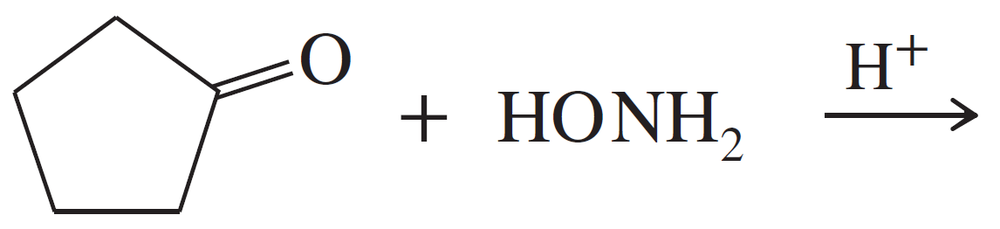
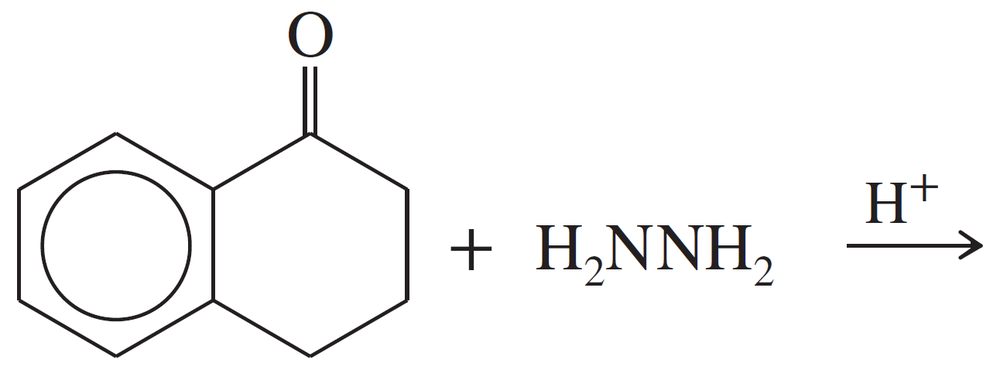
Predict the products of the following reactions.
(a)
(b)

검증된 단계별 안내
1
Step 1: Analyze the reactants and reaction conditions for both parts (a) and (b). In (a), the reactants are cyclohexanone and hydroxylamine (NH2OH) under acidic conditions (H+). In (b), the reactants are bicyclo[2.2.1]heptan-2-one and hydrazine (NH2NH2) under acidic conditions (H+).
Step 2: Recognize the type of reaction occurring. In (a), hydroxylamine reacts with a ketone to form an oxime. This is a condensation reaction where the oxygen of the ketone is replaced by the nitrogen of hydroxylamine. In (b), hydrazine reacts with a ketone to form a hydrazone, which is also a condensation reaction.
Step 3: For (a), the mechanism involves nucleophilic attack by the nitrogen of hydroxylamine on the carbonyl carbon of cyclohexanone, followed by proton transfers and elimination of water to form the oxime. The product will have the structure R-C=N-OH, where R is the cyclohexane ring.
Step 4: For (b), the mechanism involves nucleophilic attack by the nitrogen of hydrazine on the carbonyl carbon of bicyclo[2.2.1]heptan-2-one, followed by proton transfers and elimination of water to form the hydrazone. The product will have the structure R-C=N-NH2, where R is the bicyclo[2.2.1]heptane ring.
Step 5: Verify the stereochemistry and connectivity of the products. Since both reactions involve planar carbonyl groups, the stereochemistry of the products will depend on the orientation of the reactants during the reaction. Ensure the final products are correctly drawn with the appropriate functional groups (oxime for (a) and hydrazone for (b)).

비슷한 문제에 대한 검증된 영상 답변:

이 영상 해법은 위 문제에 도움이 된다고 튜터들이 추천한 것입니다.
영상 길이:
4m

주요 개념

질문에 올바르게 답하기 위해 반드시 이해해야 하는 핵심 개념들은 다음과 같습니다.

Imine and Enamine Formation

Imine and enamine formation are key reactions in organic chemistry involving the condensation of carbonyl compounds with amines. An imine is formed when a primary amine reacts with a carbonyl compound, resulting in the loss of water. In contrast, enamines are formed from secondary amines and involve a similar condensation process, but with a double bond between the nitrogen and the adjacent carbon.
추천 영상:
06:25
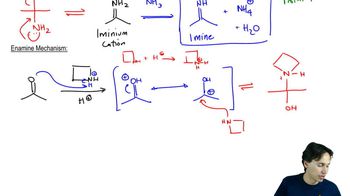
Enamine Mechanism

Acid-Catalyzed Reactions

Acid-catalyzed reactions are chemical processes that require an acid to facilitate the reaction. In the context of imine and enamine formation, the presence of an acid (H+) helps protonate the carbonyl oxygen, increasing the electrophilicity of the carbonyl carbon, making it more susceptible to nucleophilic attack by the amine. This step is crucial for the successful formation of the desired products.
추천 영상:
03:09
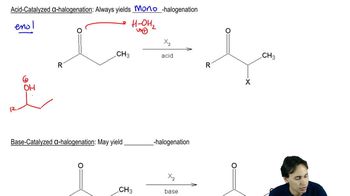
Acid Catalyzed

Nucleophilic Addition

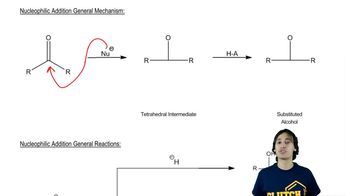
Nucleophilic addition is a fundamental reaction mechanism in organic chemistry where a nucleophile attacks an electrophilic center, typically a carbonyl carbon. In the reactions presented, the amine acts as the nucleophile, attacking the electrophilic carbon of the carbonyl group. This step is essential for forming the intermediate that ultimately leads to the production of imines or enamines.
추천 영상:
08:27
Nucleophilic Addition