Ch. 18 - Ketones and Aldehydes
Wade - Organic Chemistry 9th Edition
Wade9th EditionOrganic ChemistryISBN: 9780135213728당신이 사용하는 게 아니라요?교과서 변경
18장, 문제 15

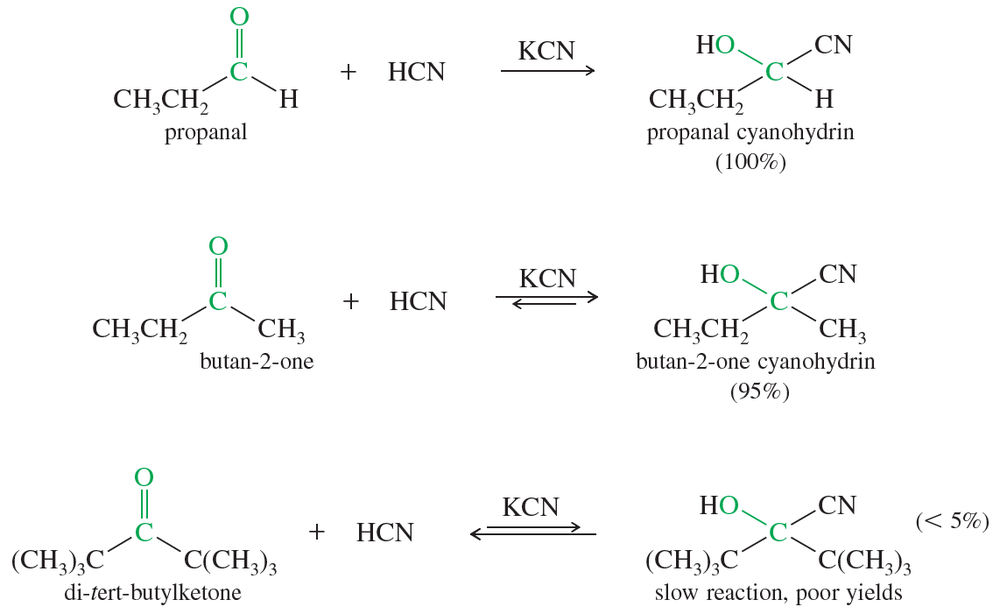
Propose a mechanism for each cyanohydrin synthesis just shown.

검증된 단계별 안내
1
Step 1: Identify the starting material and the reagent. In each case, the starting material is either an aldehyde or a ketone, and the reagent is hydrogen cyanide (HCN). The reaction is catalyzed by cyanide ions (CN⁻).
Step 2: Understand the mechanism. The cyanohydrin synthesis involves nucleophilic addition of the cyanide ion (CN⁻) to the carbonyl group (C=O) of the aldehyde or ketone. This is followed by protonation of the resulting alkoxide intermediate.
Step 3: Initiate the reaction. The cyanide ion (CN⁻) attacks the electrophilic carbon atom of the carbonyl group, breaking the π bond and forming a tetrahedral intermediate. Represent this step as: C1(C=O)+CN-C1(C-O-CN-)
Step 4: Protonation of the intermediate. The negatively charged oxygen atom in the tetrahedral intermediate is protonated by HCN, forming the cyanohydrin product. Represent this step as: C1(C-O-CN-)+HCNC1(C-OH-CN-)
Step 5: Analyze the steric and electronic effects. The yield of cyanohydrin depends on the steric hindrance around the carbonyl group. For propanal, the reaction proceeds efficiently due to minimal steric hindrance. For butan-2-one, the yield is slightly lower due to increased steric hindrance. For di-tert-butylketone, the reaction is slow and yields are poor due to significant steric hindrance around the carbonyl group.

비슷한 문제에 대한 검증된 영상 답변:

이 영상 해법은 위 문제에 도움이 된다고 튜터들이 추천한 것입니다.
영상 길이:
2m

주요 개념

질문에 올바르게 답하기 위해 반드시 이해해야 하는 핵심 개념들은 다음과 같습니다.

Cyanohydrin Formation

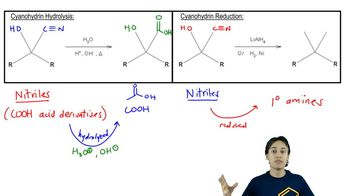
Cyanohydrins are formed through the nucleophilic addition of hydrogen cyanide (HCN) to carbonyl compounds, such as aldehydes or ketones. In this reaction, the nucleophile (cyanide ion) attacks the electrophilic carbon of the carbonyl group, leading to the formation of a hydroxyl group and a cyano group on the same carbon atom.
추천 영상:
02:36
Nitrile Reduction

Nucleophilic Addition Mechanism

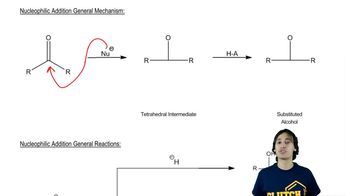
The nucleophilic addition mechanism involves the attack of a nucleophile on an electrophile, resulting in the formation of a new bond. In the case of cyanohydrin synthesis, the cyanide ion acts as the nucleophile, while the carbonyl carbon serves as the electrophile. This mechanism typically includes a tetrahedral intermediate before the final product is formed.
추천 영상:
08:27
Nucleophilic Addition

Stereochemistry of Cyanohydrins

Cyanohydrins can exhibit stereochemistry due to the presence of a chiral center formed during their synthesis. The addition of HCN to the carbonyl carbon can lead to the formation of two enantiomers, depending on the orientation of the nucleophile's attack. Understanding the stereochemical implications is crucial for predicting the properties and reactivity of the resulting cyanohydrins.
추천 영상:
가이드 코스
1:38
Polymer Stereochemistry Concept 1