Propose a mechanism for each cyanohydrin synthesis just shown.
Ch. 18 - Ketones and Aldehydes
18장, 문제 12b
Sodium triacetoxyborohydride, NaBH(OAc)3, is a mild reducing agent that reduces aldehydes much more quickly than ketones. It can be used to reduce aldehydes in the presence of ketones, such as in the following reaction:

(b) Propose a mechanism for the reduction of an aldehyde by sodium triacetoxyborohydride.
검증된 단계별 안내1
Step 1: Recognize the role of sodium triacetoxyborohydride (NaBH(OAc)3) as a mild reducing agent. It selectively reduces aldehydes to alcohols in the presence of ketones due to its preference for the more reactive carbonyl group of aldehydes.
Step 2: Identify the aldehyde functional group in the reactant molecule. The aldehyde group is characterized by a carbonyl group (C=O) bonded to a hydrogen atom. In the provided reaction, the aldehyde group is located at the terminal position of the molecule.
Step 3: Propose the mechanism for the reduction. The hydride ion (H⁻) from NaBH(OAc)3 attacks the electrophilic carbon of the aldehyde's carbonyl group. This nucleophilic attack leads to the formation of a tetrahedral intermediate.
Step 4: The tetrahedral intermediate undergoes protonation, facilitated by the acetic acid (CH3COOH) present in the reaction. This step converts the intermediate into the final alcohol product, where the aldehyde is reduced to a primary alcohol.
Step 5: Note that the ketone group remains unaffected during the reaction because sodium triacetoxyborohydride is selective for aldehydes. The ketone group retains its carbonyl structure in the product.

비슷한 문제에 대한 검증된 영상 답변:
이 영상 해법은 위 문제에 도움이 된다고 튜터들이 추천한 것입니다.
영상 길이:
4m주요 개념
질문에 올바르게 답하기 위해 반드시 이해해야 하는 핵심 개념들은 다음과 같습니다.
Reduction Reactions
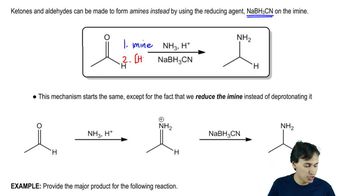
Reduction reactions involve the gain of electrons or the decrease in oxidation state by a molecule. In organic chemistry, this often refers to the conversion of carbonyl compounds, such as aldehydes and ketones, into alcohols. Sodium triacetoxyborohydride (NaBH(OAc)3) is a mild reducing agent that selectively reduces aldehydes more rapidly than ketones, making it useful in synthetic organic chemistry.
추천 영상:
Reductive Amination
Mechanism of Aldehyde Reduction
The mechanism of aldehyde reduction typically involves the nucleophilic attack of a hydride ion (H-) on the carbonyl carbon, leading to the formation of an alkoxide intermediate. This intermediate can then be protonated to yield the corresponding alcohol. Understanding this mechanism is crucial for predicting the outcome of reactions involving aldehydes and reducing agents like sodium triacetoxyborohydride.
추천 영상:
Birch Reduction Mechanism
Selectivity in Reductions
Selectivity in reductions refers to the ability of a reducing agent to preferentially react with one functional group over another. In the case of sodium triacetoxyborohydride, its selectivity allows it to reduce aldehydes in the presence of ketones, which is significant in complex organic syntheses. This selectivity is influenced by the sterics and electronics of the substrates involved.
추천 영상:
Reductive Amination
관련 실천
교과서 질문
1013
views
교과서 질문
Propose mechanisms for
(b) the base-catalyzed hydration of acetone to form acetone hydrate.
904
views
교과서 질문
Show how you would accomplish the following synthetic conversions. You may use any additional reagents and solvents you need.
(b)
1432
views
교과서 질문
Show how you would accomplish the following synthetic conversions. You may use any additional reagents and solvents you need.
(d)
802
views
교과서 질문
Sodium triacetoxyborohydride, NaBH(OAc)3, is a mild reducing agent that reduces aldehydes much more quickly than ketones. It can be used to reduce aldehydes in the presence of ketones, such as in the following reaction:
(a) Draw a complete Lewis structure for sodium triacetoxyborohydride.
1915
views
교과서 질문
Propose mechanisms for
(a) the acid-catalyzed hydration of chloral to form chloral hydrate.
868
views