Ch. 18 - Ketones and Aldehydes
Wade - Organic Chemistry 9th Edition
Wade9th EditionOrganic ChemistryISBN: 9780135213728당신이 사용하는 게 아니라요?교과서 변경
18장, 문제 29c

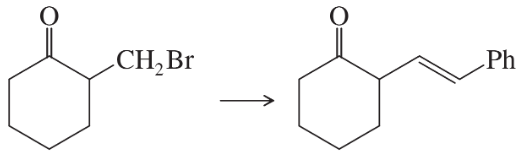
Show how you would accomplish the following syntheses. You may use whatever additional reagents you need.
(c)

검증된 단계별 안내
1
Step 1: Analyze the starting material and the product. The starting material is a bromomethyl ketone, and the product is an α,β-unsaturated ketone with a phenyl group attached to the β-carbon. This suggests that the reaction involves a substitution followed by elimination.
Step 2: Perform a nucleophilic substitution reaction. Use a phenyl nucleophile, such as a phenyl Grignard reagent (PhMgBr) or phenyl lithium (PhLi), to replace the bromine atom with a phenyl group. This step generates an intermediate with a phenyl group attached to the α-carbon.
Step 3: Introduce conditions for elimination. Use a base, such as potassium tert-butoxide (KOtBu) or sodium hydride (NaH), to promote the elimination of a proton from the α-carbon and the formation of a double bond between the α- and β-carbons. This step results in the formation of the α,β-unsaturated ketone.
Step 4: Ensure stereochemistry and regioselectivity. Verify that the elimination occurs in the correct position to yield the desired conjugated system with the phenyl group attached to the β-carbon.
Step 5: Purify the product. Use techniques such as distillation or chromatography to isolate the α,β-unsaturated ketone with the phenyl group attached to the β-carbon.

비슷한 문제에 대한 검증된 영상 답변:

이 영상 해법은 위 문제에 도움이 된다고 튜터들이 추천한 것입니다.
영상 길이:
6m

주요 개념

질문에 올바르게 답하기 위해 반드시 이해해야 하는 핵심 개념들은 다음과 같습니다.

Nucleophilic Substitution

Nucleophilic substitution is a fundamental reaction in organic chemistry where a nucleophile attacks an electrophilic carbon atom, replacing a leaving group. In this synthesis, the bromine atom in CH2Br acts as a leaving group, allowing the nucleophile to form a new bond with the carbon atom. Understanding this mechanism is crucial for predicting the outcome of the reaction.
추천 영상:
01:47
Nucleophiles and Electrophiles can react in Substitution Reactions.

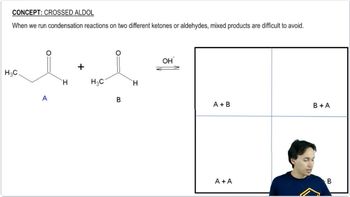
Aldol Condensation

Aldol condensation is a reaction between aldehydes or ketones that contain alpha-hydrogens, leading to the formation of β-hydroxy aldehydes or ketones, which can further dehydrate to form α,β-unsaturated carbonyl compounds. This process is essential in the synthesis shown, as it allows for the formation of the desired product through the coupling of two carbonyl compounds.
추천 영상:
09:51
Crossed Aldol

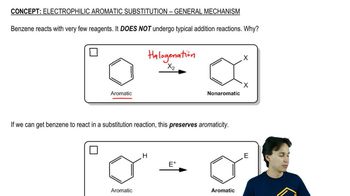
Electrophilic Aromatic Substitution

Electrophilic aromatic substitution is a reaction where an electrophile replaces a hydrogen atom on an aromatic ring. In the context of the provided synthesis, the phenyl group (Ph) can be introduced to the aromatic compound through this mechanism, allowing for the formation of the final product. Recognizing the role of aromaticity and the stability of the intermediates is key to understanding this step.
추천 영상:
03:07
EAS Review