Ch. 18 - Ketones and Aldehydes
Wade - Organic Chemistry 9th Edition
Wade9th EditionOrganic ChemistryISBN: 9780135213728당신이 사용하는 게 아니라요?교과서 변경
18장, 문제 59

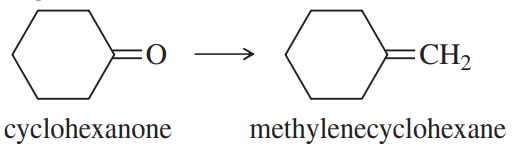
The Wittig reaction is useful for placing double bonds in less stable positions. For example, the following transformation is easily accomplished using a Wittig reaction.
Transformation of cyclohexanone to methylene cyclohexane using a Wittig reaction, illustrated with chemical structures.
(a) Show how you would use a Wittig reaction to do this.
(b) Show how you might do this without using a Wittig reaction, and then explain why the Wittig reaction is a much better synthesis.

검증된 단계별 안내
1
Step 1: Understand the Wittig reaction mechanism. The Wittig reaction involves the reaction of an aldehyde or ketone with a phosphonium ylide to form an alkene. The ylide is typically generated from a phosphonium salt, which is formed by the reaction of a triphenylphosphine with an alkyl halide.
Step 2: Identify the starting materials for the Wittig reaction. You need a phosphonium ylide and a carbonyl compound (aldehyde or ketone). Determine the structure of the ylide and the carbonyl compound that will lead to the desired alkene product.
Step 3: Outline the Wittig reaction process. The ylide attacks the carbonyl carbon, forming a betaine intermediate. This intermediate then undergoes a rearrangement to form the alkene and triphenylphosphine oxide as a byproduct.
Step 4: Consider an alternative method without using the Wittig reaction. One possible method is the use of a dehydration reaction of an alcohol to form an alkene. This involves converting the alcohol to a good leaving group, such as a tosylate, followed by elimination.
Step 5: Compare the Wittig reaction with the alternative method. The Wittig reaction is often preferred because it allows for precise control over the position and stereochemistry of the double bond, whereas other methods may lead to mixtures of products or less control over the double bond placement.

비슷한 문제에 대한 검증된 영상 답변:

이 영상 해법은 위 문제에 도움이 된다고 튜터들이 추천한 것입니다.
영상 길이:
4m

주요 개념

질문에 올바르게 답하기 위해 반드시 이해해야 하는 핵심 개념들은 다음과 같습니다.

Wittig Reaction

The Wittig reaction is a chemical reaction that allows for the formation of alkenes by reacting an aldehyde or ketone with a phosphonium ylide. This reaction is particularly valuable in organic synthesis because it enables the introduction of double bonds in specific positions, often leading to less stable isomers that are difficult to achieve through other methods.
추천 영상:
15:39
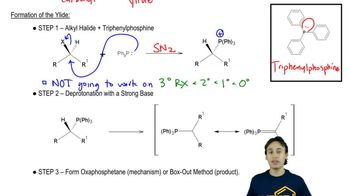
Box-Out Method and Full-Mechanism

Phosphonium Ylide

A phosphonium ylide is a compound formed by the deprotonation of a phosphonium salt, resulting in a species with a positively charged phosphorus atom and a negatively charged carbon atom. This ylide acts as a nucleophile in the Wittig reaction, attacking the carbonyl carbon of aldehydes or ketones to form an alkene after subsequent elimination of the phosphine oxide.
추천 영상:
15:39
Box-Out Method and Full-Mechanism

Alternative Synthesis Methods

Alternative synthesis methods for forming alkenes may include elimination reactions, such as E2 or E1 mechanisms, or other coupling reactions. However, these methods often require more steps, harsher conditions, or lead to less selective outcomes compared to the Wittig reaction, which is favored for its efficiency and ability to control the position and stereochemistry of the resulting double bond.
추천 영상:
가이드 코스
1:24
Amino Acid Synthesis: HVZ Method Concept 1