Ch. 18 - Ketones and Aldehydes
Wade - Organic Chemistry 9th Edition
Wade9th EditionOrganic ChemistryISBN: 9780135213728당신이 사용하는 게 아니라요?교과서 변경
18장, 문제 58

When LiAlH4 reduces 3-methylcyclopentanone, the product mixture contains 60% cis-3-methylcyclopentanol and 40% trans-3-methylcyclopentanol. Use your models, and make three-dimensional drawings to explain this preference for the cis isomer.

검증된 단계별 안내
1
Understand the reaction: Lithium aluminum hydride (LiAlH4) is a strong reducing agent that reduces ketones, such as 3-methylcyclopentanone, to their corresponding alcohols. The reduction occurs via a nucleophilic attack of the hydride ion (H⁻) on the carbonyl carbon.
Analyze the stereochemistry of the starting material: 3-methylcyclopentanone is a cyclic ketone with a methyl group at the 3-position. The carbonyl group is planar (sp² hybridized), allowing the hydride to attack from either the top face or the bottom face of the molecule.
Consider the steric effects during the hydride attack: The methyl group at the 3-position creates steric hindrance. When the hydride attacks from the same face as the methyl group, the resulting alcohol will have the methyl and hydroxyl groups in a cis configuration. When the hydride attacks from the opposite face, the product will have a trans configuration.
Explain the preference for the cis isomer: The cis isomer is favored because the transition state for hydride attack on the same face as the methyl group is less sterically hindered. In the trans configuration, the bulky methyl and hydroxyl groups are on opposite sides, leading to greater steric strain in the transition state.
Summarize the product distribution: The reaction produces a mixture of cis-3-methylcyclopentanol (60%) and trans-3-methylcyclopentanol (40%) due to the steric preference for the cis isomer during the reduction process. This preference is a result of the lower steric hindrance in the transition state leading to the cis product.

비슷한 문제에 대한 검증된 영상 답변:

이 영상 해법은 위 문제에 도움이 된다고 튜터들이 추천한 것입니다.
영상 길이:
5m

주요 개념

질문에 올바르게 답하기 위해 반드시 이해해야 하는 핵심 개념들은 다음과 같습니다.

Reduction Reactions

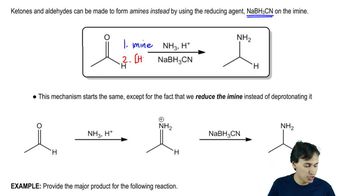
Reduction reactions involve the gain of electrons or hydrogen, or the loss of oxygen. In organic chemistry, reducing agents like lithium aluminum hydride (LiAlH4) are used to convert carbonyl compounds, such as ketones, into alcohols. Understanding the mechanism of reduction is crucial for predicting the products formed during the reaction.
추천 영상:
07:12
Reductive Amination

Stereochemistry

Stereochemistry is the study of the spatial arrangement of atoms in molecules and how this affects their chemical behavior. In the case of 3-methylcyclopentanone reduction, the formation of cis and trans isomers is influenced by the steric and electronic interactions during the reaction. Recognizing the differences between these isomers helps explain the observed product distribution.
추천 영상:
가이드 코스
1:38
Polymer Stereochemistry Concept 1

Steric Hindrance

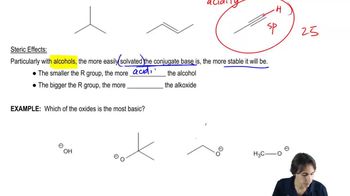
Steric hindrance refers to the repulsion between bulky groups in a molecule that can affect the reactivity and stability of intermediates. In the reduction of 3-methylcyclopentanone, the steric environment around the cyclopentane ring influences the formation of the cis isomer, which is favored due to less steric strain compared to the trans isomer. This concept is essential for understanding why certain isomers are produced preferentially.
추천 영상:
02:53
Understanding steric effects.