
Ch. 19 - Amines
Wade - Organic Chemistry 9th Edition
Wade9th EditionOrganic ChemistryISBN: 9780135213728당신이 사용하는 게 아니라요?교과서 변경
19장, 문제 54b

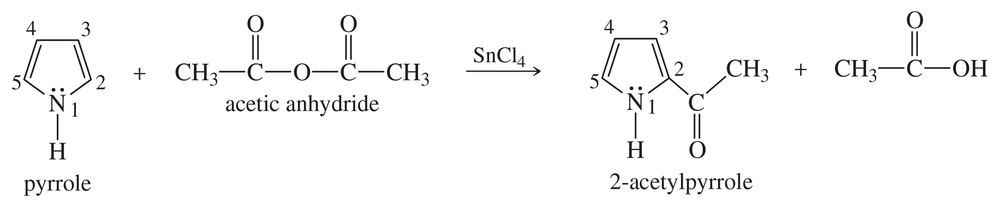
Pyrrole undergoes electrophilic aromatic substitution more readily than benzene, and mild reagents and conditions are sufficient. These reactions normally occur at the 2-position rather than the 3-position, as shown in the following example.

b. Explain why pyrrole reacts more readily than benzene, and also why substitution occurs primarily at the 2-position rather than the 3-position.

검증된 단계별 안내
1
Step 1: Understand the structure and reactivity of pyrrole. Pyrrole is a five-membered aromatic heterocycle containing a nitrogen atom. The lone pair of electrons on the nitrogen is delocalized into the aromatic ring, increasing the electron density of the ring and making it more reactive toward electrophilic aromatic substitution compared to benzene.
Step 2: Compare pyrrole and benzene in terms of electron density. Benzene is a six-membered aromatic ring with delocalized π-electrons, but it lacks the additional electron-donating effect present in pyrrole. The nitrogen atom in pyrrole contributes electron density to the ring, making pyrrole more nucleophilic and reactive toward electrophiles.
Step 3: Analyze the regioselectivity of substitution in pyrrole. Substitution occurs primarily at the 2-position (adjacent to the nitrogen) because this position is more stabilized in the transition state due to resonance. When an electrophile attacks the 2-position, the resulting intermediate carbocation can be stabilized by resonance structures involving the nitrogen atom.
Step 4: Explain why substitution at the 3-position is less favorable. Substitution at the 3-position does not benefit from the same degree of resonance stabilization as substitution at the 2-position. The resonance structures involving the nitrogen atom are less effective in stabilizing the intermediate carbocation formed during substitution at the 3-position.
Step 5: Relate the reaction conditions to the reactivity of pyrrole. The reaction shown in the image involves acetic anhydride and SnCl4 as a catalyst. These mild conditions are sufficient for pyrrole to undergo electrophilic aromatic substitution due to its high reactivity, whereas benzene would require harsher conditions to achieve a similar reaction.

비슷한 문제에 대한 검증된 영상 답변:

이 영상 해법은 위 문제에 도움이 된다고 튜터들이 추천한 것입니다.
영상 길이:
10m
도움이 되었나요?

주요 개념

질문에 올바르게 답하기 위해 반드시 이해해야 하는 핵심 개념들은 다음과 같습니다.

Electrophilic Aromatic Substitution (EAS)

Electrophilic Aromatic Substitution is a fundamental reaction in organic chemistry where an electrophile replaces a hydrogen atom on an aromatic ring. This process is facilitated by the electron-rich nature of the aromatic system, which stabilizes the formation of a carbocation intermediate. Pyrrole, with its nitrogen atom contributing to the electron density, is more reactive than benzene, allowing it to undergo EAS more readily.
추천 영상:
03:07
EAS Review

Aromaticity and Electron Density

Aromatic compounds, like pyrrole and benzene, exhibit unique stability due to their cyclic, planar structure and delocalized π-electrons. Pyrrole has a nitrogen atom that donates electron density into the ring, increasing its overall reactivity compared to benzene, which lacks such electron-donating groups. This enhanced electron density makes pyrrole more susceptible to electrophilic attack.
추천 영상:
08:19
Intro to Aromaticity

Regioselectivity in Substitution Reactions

Regioselectivity refers to the preference of a chemical reaction to yield one structural isomer over others. In the case of pyrrole, electrophilic substitution predominantly occurs at the 2-position due to the stability of the intermediate formed during the reaction. The 2-position allows for resonance stabilization involving the nitrogen atom, while substitution at the 3-position is less favorable due to reduced resonance stabilization.
추천 영상:
01:34
Recognizing Substitution Reactions.