

Ch. 19 - Amines
Wade - Organic Chemistry 9th Edition
Wade9th EditionOrganic ChemistryISBN: 9780135213728당신이 사용하는 게 아니라요?교과서 변경
19장, 문제 51c

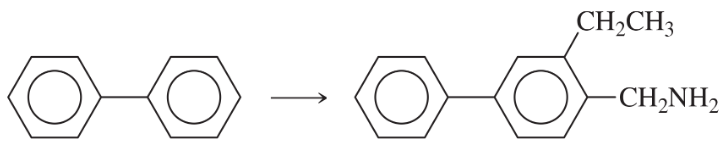
Using any necessary reagents, show how you can accomplish the following multistep syntheses.
(c)

검증된 단계별 안내
1
Step 1: Begin by identifying the target molecule and the starting material. The starting material is biphenyl, and the target molecule has two functional groups added: an ethyl group (-CH2CH3) and an aminomethyl group (-CH2NH2).
Step 2: Introduce the ethyl group onto one of the benzene rings of biphenyl. This can be achieved through Friedel-Crafts alkylation using ethyl chloride (CH3CH2Cl) and a Lewis acid catalyst such as AlCl3. This reaction selectively adds the ethyl group to the benzene ring.
Step 3: Introduce the aminomethyl group (-CH2NH2) onto the other benzene ring. This can be done by first performing a chloromethylation reaction using formaldehyde (HCHO) and hydrochloric acid (HCl) to add a chloromethyl group (-CH2Cl).
Step 4: Convert the chloromethyl group (-CH2Cl) into an aminomethyl group (-CH2NH2) by treating the intermediate with ammonia (NH3) in a nucleophilic substitution reaction. This replaces the chlorine atom with an amino group.
Step 5: Verify the structure of the final product to ensure that the ethyl group and aminomethyl group are correctly positioned on the biphenyl framework. This completes the synthesis.

비슷한 문제에 대한 검증된 영상 답변:

이 영상 해법은 위 문제에 도움이 된다고 튜터들이 추천한 것입니다.
영상 길이:
3m
도움이 되었나요?

주요 개념

질문에 올바르게 답하기 위해 반드시 이해해야 하는 핵심 개념들은 다음과 같습니다.

Multistep Synthesis

Multistep synthesis involves a series of chemical reactions that transform starting materials into a desired product through intermediate compounds. Each step typically requires specific reagents and conditions, and understanding the sequence of reactions is crucial for successful synthesis. This concept is fundamental in organic chemistry for constructing complex molecules from simpler ones.
추천 영상:
02:15
Multistep Synthesis

Reduction Reactions

Reduction reactions involve the gain of electrons or hydrogen, or the loss of oxygen, resulting in the conversion of a compound to a more reduced state. In organic chemistry, this often refers to the transformation of carbonyl groups to alcohols or the reduction of nitro groups to amines. Recognizing the appropriate reducing agents, such as lithium aluminum hydride or hydrogen gas with a catalyst, is essential for executing these reactions.
추천 영상:
07:12
Reductive Amination

Functional Group Transformation

Functional group transformation refers to the process of converting one functional group into another, which is a key aspect of organic synthesis. In the provided reaction, an aromatic compound is transformed to introduce an ethyl group and an amine group. Understanding how different functional groups react and the conditions required for their transformation is vital for designing effective synthetic pathways.
추천 영상:
02:36
Identifying Functional Groups
관련 실천
교과서 질문

Pyrrole undergoes electrophilic aromatic substitution more readily than benzene, and mild reagents and conditions are sufficient. These reactions normally occur at the 2-position rather than the 3-position, as shown in the following example.

b. Explain why pyrrole reacts more readily than benzene, and also why substitution occurs primarily at the 2-position rather than the 3-position.

2788
views
교과서 질문

Show how you can synthesize the following compounds starting with benzene, toluene, and alcohols containing no more than four carbon atoms as your organic starting materials. Assume that para is the major product (and separable from ortho) in ortho, para mixtures.

(d) N-benzylpropan-1-amine

619
views
교과서 질문

The following spectra for A and B correspond to two structural isomers. The NMR singlet at δ1.16 in spectrum A disappears when the sample is shaken with D2O. The singlet at δ0.6 ppm in the spectrum of B disappears on shaking with D2O. Propose structures for these isomers, and show how your structures correspond to the spectra. Show what cleavage is responsible for the base peak at m/z 44 in the mass spectrum of A and the prominent peak at m/z 58 in the mass spectrum of B.

<IMAGE>

1583
views
교과서 질문

Using any necessary reagents, show how you can accomplish the following multistep syntheses.

(b)

913
views
교과서 질문

Show how you can synthesize the following compounds starting with benzene, toluene, and alcohols containing no more than four carbon atoms as your organic starting materials. Assume that para is the major product (and separable from ortho) in ortho, para mixtures.

(g) 4-isobutylaniline

958
views
교과서 질문

Pyrrole undergoes electrophilic aromatic substitution more readily than benzene, and mild reagents and conditions are sufficient. These reactions normally occur at the 2-position rather than the 3-position, as shown in the following example.

a. Propose a mechanism for the acetylation of pyrrole just shown. You may begin with pyrrole and the acylium ion, CH3C≡O+. Be careful to draw all the resonance structures of the intermediate.

4010
views