
Ch. 19 - Amines
Wade - Organic Chemistry 9th Edition
Wade9th EditionOrganic ChemistryISBN: 9780135213728당신이 사용하는 게 아니라요?교과서 변경
19장, 문제 42g

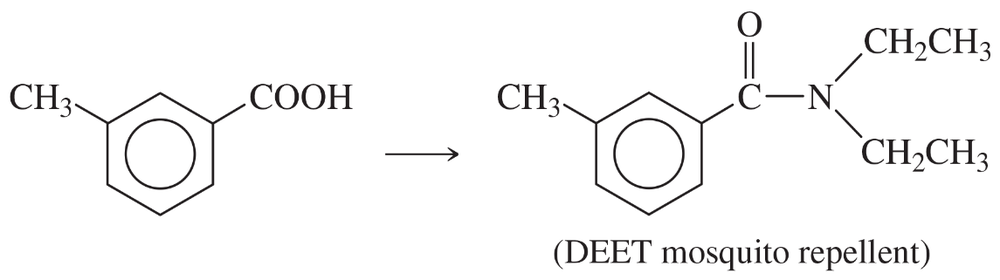
Using any necessary reagents, show how you would accomplish the following syntheses.
(g)

검증된 단계별 안내
1
Step 1: Analyze the starting material and product. The starting material is a carboxylic acid, and the product is an amide. This transformation involves converting the carboxylic acid functional group (-COOH) into an amide (-CONR2).
Step 2: To convert a carboxylic acid into an amide, first activate the carboxylic acid. This can be done by converting it into an acid chloride using reagents like thionyl chloride (SOCl2) or oxalyl chloride. The reaction replaces the hydroxyl group (-OH) with a chlorine atom (-Cl), forming an acid chloride.
Step 3: Once the acid chloride is formed, it can react with an amine to form the desired amide. In this case, the amine used is diethylamine (H-N(CH2CH3)2). The nucleophilic amine attacks the carbonyl carbon of the acid chloride, leading to the formation of the amide bond.
Step 4: During the reaction between the acid chloride and the amine, a byproduct such as HCl is formed. To neutralize this byproduct, a base like pyridine or triethylamine can be added to the reaction mixture.
Step 5: After the reaction is complete, purify the product using techniques like extraction or recrystallization to isolate the desired amide.

비슷한 문제에 대한 검증된 영상 답변:

이 영상 해법은 위 문제에 도움이 된다고 튜터들이 추천한 것입니다.
영상 길이:
3m
도움이 되었나요?

주요 개념

질문에 올바르게 답하기 위해 반드시 이해해야 하는 핵심 개념들은 다음과 같습니다.

Carboxylic Acids

Carboxylic acids are organic compounds characterized by the presence of a carboxyl group (-COOH). They are known for their acidic properties and can undergo various reactions, including esterification and conversion to acid chlorides. Understanding their structure and reactivity is crucial for predicting the outcomes of synthetic transformations.
추천 영상:
04:20
Carboxylic Acids Nomenclature

Acid Chlorides

Acid chlorides, also known as acyl chlorides, are derivatives of carboxylic acids where the hydroxyl group is replaced by a chlorine atom. They are highly reactive and serve as important intermediates in organic synthesis, particularly in the formation of amides and esters. Recognizing their formation from carboxylic acids is essential for understanding the reaction mechanisms involved.
추천 영상:
03:13
Acid Chloride Nomenclature

Reagents for Conversion

The conversion of carboxylic acids to acid chlorides typically involves reagents such as thionyl chloride (SOCl2), oxalyl chloride (COCl)2, or phosphorus pentachloride (PCl5). These reagents facilitate the substitution of the hydroxyl group with a chlorine atom, enabling the transformation. Familiarity with these reagents and their mechanisms is vital for successful synthesis in organic chemistry.
추천 영상:
04:30
Comparing and contrasting the Alcohol Conversions.