Ch. 19 - Amines
Wade - Organic Chemistry 9th Edition
Wade9th EditionOrganic ChemistryISBN: 9780135213728당신이 사용하는 게 아니라요?교과서 변경
19장, 문제 42c

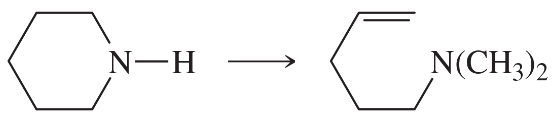
Using any necessary reagents, show how you would accomplish the following syntheses.
(c)

검증된 단계별 안내
1
Step 1: Begin with the starting material, piperidine (a cyclic secondary amine). The goal is to methylate the nitrogen atom and introduce a double bond in the ring structure.
Step 2: Use methyl iodide (CH3I) or dimethyl sulfate as a methylating agent to add two methyl groups to the nitrogen atom. This reaction typically occurs via nucleophilic substitution, where the lone pair on the nitrogen attacks the methylating agent.
Step 3: To introduce the double bond in the ring, perform a dehydrogenation reaction. This can be achieved using a strong base such as potassium tert-butoxide (KOtBu) or sodium hydride (NaH) to abstract a proton, leading to the formation of the double bond.
Step 4: Ensure the reaction conditions are controlled to avoid overreaction or side reactions. For example, use an appropriate solvent like tetrahydrofuran (THF) or dimethylformamide (DMF) to facilitate the reaction.
Step 5: Purify the product using techniques such as distillation or chromatography to isolate the desired compound, N,N-dimethyl-2,3-dihydropyrrole.

비슷한 문제에 대한 검증된 영상 답변:

이 영상 해법은 위 문제에 도움이 된다고 튜터들이 추천한 것입니다.
영상 길이:
5m
도움이 되었나요?

주요 개념

질문에 올바르게 답하기 위해 반드시 이해해야 하는 핵심 개념들은 다음과 같습니다.

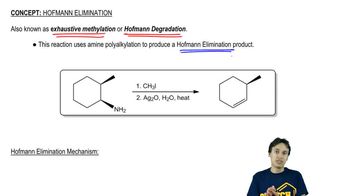
Hofmann Elimination

Hofmann elimination is a chemical reaction that involves the conversion of primary amines to alkenes through the formation of an N-chloroamine intermediate. This process typically requires the use of reagents such as chlorine or bromine in the presence of a base, leading to the elimination of an amine and the formation of an alkene. Understanding this mechanism is crucial for synthesizing specific alkenes from amines.
추천 영상:
03:22
General Reaction

Reagents and Conditions

The choice of reagents and reaction conditions is vital in organic synthesis. In Hofmann elimination, reagents like sodium hypochlorite or bromine are commonly used to generate the N-chloroamine, while a strong base, such as sodium hydroxide, facilitates the elimination step. Recognizing the appropriate reagents and their roles helps in successfully executing the synthesis.
추천 영상:
01:52
Reagents

Mechanism of Elimination Reactions

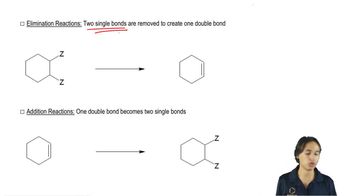
Elimination reactions involve the removal of atoms or groups from a molecule, resulting in the formation of a double bond. In the context of Hofmann elimination, the mechanism includes the formation of a cyclic intermediate followed by the loss of a leaving group and a proton, leading to the creation of an alkene. A solid grasp of elimination mechanisms is essential for predicting the products of such reactions.
추천 영상:
00:40
Recognizing Elimination Reactions.