Ch. 21 - Carboxylic Acid Derivatives
Wade - Organic Chemistry 9th Edition
Wade9th EditionOrganic ChemistryISBN: 9780135213728당신이 사용하는 게 아니라요?교과서 변경
21장, 문제 13

Acid-catalyzed transesterification:
 
Complete the mechanism for this acid-catalyzed transesterification by drawing out all the individual steps. Draw the important resonance contributors for each resonance-stabilized intermediate.

검증된 단계별 안내
1
Step 1: Protonation of the carbonyl oxygen. The acid catalyst (H⁺) donates a proton to the oxygen atom of the carbonyl group, increasing the electrophilicity of the carbonyl carbon. This step makes the carbonyl carbon more susceptible to nucleophilic attack.
Step 2: Nucleophilic attack by methanol (CH₃OH). The lone pair of electrons on the oxygen atom of methanol attacks the carbonyl carbon, forming a tetrahedral intermediate. This intermediate contains both the original ester group and the newly added methanol group.
Step 3: Proton transfer within the intermediate. A proton is transferred from the methanol group to the original ester oxygen, stabilizing the intermediate and preparing it for the next step. This step may involve resonance stabilization of the intermediate.
Step 4: Elimination of the leaving group. The ethoxy group (CH₂CH₃O⁻) is eliminated as the leaving group, forming ethanol (CH₃CH₂OH). This step restores the carbonyl group and completes the transesterification process.
Step 5: Deprotonation of the carbonyl oxygen. The protonated carbonyl oxygen loses a proton, regenerating the acid catalyst (H⁺) and yielding the final product, methyl benzoate (C₆H₅COOCH₃).

비슷한 문제에 대한 검증된 영상 답변:

이 영상 해법은 위 문제에 도움이 된다고 튜터들이 추천한 것입니다.
영상 길이:
10m

주요 개념

질문에 올바르게 답하기 위해 반드시 이해해야 하는 핵심 개념들은 다음과 같습니다.

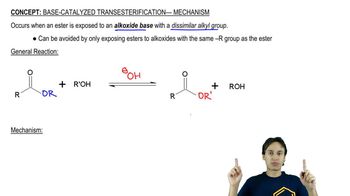
Transesterification

Transesterification is a chemical reaction where an ester is converted into another ester through the exchange of the alkoxy group. This process typically involves the reaction of an alcohol with an ester in the presence of an acid catalyst, which enhances the reaction rate. Understanding this concept is crucial for analyzing the mechanism, as it outlines the fundamental transformation occurring in the reaction.
추천 영상:
02:49
General Reaction

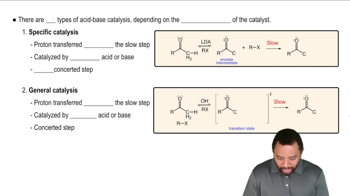
Acid Catalysis

Acid catalysis involves the use of an acid to increase the rate of a chemical reaction by providing protons (H+) to reactants. In the context of transesterification, the acid catalyst protonates the carbonyl oxygen of the ester, making it more electrophilic and susceptible to nucleophilic attack by the alcohol. This concept is essential for understanding how the reaction proceeds and the role of the catalyst in stabilizing intermediates.
추천 영상:
가이드 코스
2:50
Acid-Base Catalysis Concept 3

Resonance Stabilization

Resonance stabilization refers to the delocalization of electrons in a molecule, which can occur when multiple valid Lewis structures (resonance contributors) can be drawn. In the context of the transesterification mechanism, resonance stabilization of intermediates helps to lower the energy of these species, making them more stable and facilitating the reaction. Recognizing the resonance contributors is vital for accurately depicting the mechanism and understanding the stability of intermediates.
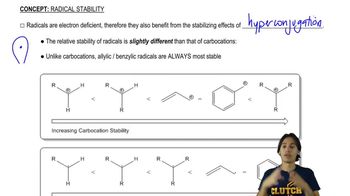
추천 영상:
03:43
The radical stability trend.