Ch. 21 - Carboxylic Acid Derivatives
Wade - Organic Chemistry 9th Edition
Wade9th EditionOrganic ChemistryISBN: 9780135213728당신이 사용하는 게 아니라요?교과서 변경
21장, 문제 22

Propose a mechanism for the basic hydrolysis of benzonitrile to the benzoate ion and ammonia.

검증된 단계별 안내
1
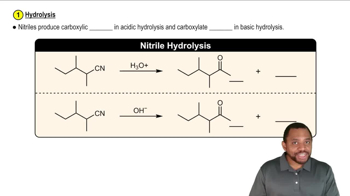
Identify the functional group in benzonitrile: The nitrile group (-C≡N) is a triple bond between carbon and nitrogen. In basic hydrolysis, this group is converted into a carboxylate ion (-COO⁻) and ammonia (NH₃).
Recognize the role of the base: The hydroxide ion (OH⁻) acts as a nucleophile and attacks the electrophilic carbon in the nitrile group, breaking the triple bond and forming an intermediate imidate ion.
Describe the intermediate hydrolysis step: The imidate ion undergoes further reaction with water, leading to the formation of an amide intermediate (benzamide). This step involves proton transfer and rearrangement.
Explain the second nucleophilic attack: The hydroxide ion attacks the carbonyl carbon of the amide, leading to the cleavage of the C-N bond and the formation of a tetrahedral intermediate.
Conclude with the final products: The tetrahedral intermediate collapses, releasing ammonia (NH₃) and forming the benzoate ion (C₆H₅COO⁻) as the final products of the reaction.

비슷한 문제에 대한 검증된 영상 답변:

이 영상 해법은 위 문제에 도움이 된다고 튜터들이 추천한 것입니다.
영상 길이:
4m

주요 개념

질문에 올바르게 답하기 위해 반드시 이해해야 하는 핵심 개념들은 다음과 같습니다.

Nucleophilic Substitution

Nucleophilic substitution is a fundamental reaction mechanism in organic chemistry where a nucleophile attacks an electrophile, resulting in the replacement of a leaving group. In the case of benzonitrile hydrolysis, water acts as a nucleophile, attacking the carbon atom of the nitrile group, leading to the formation of an intermediate that eventually yields benzoate and ammonia.
추천 영상:
01:47
Nucleophiles and Electrophiles can react in Substitution Reactions.

Hydrolysis of Nitriles

Hydrolysis of nitriles involves the reaction of a nitrile with water, typically under basic or acidic conditions, to convert it into a carboxylic acid and ammonia. In this process, the nitrile carbon is converted to a carboxylate ion, while the nitrogen is released as ammonia, highlighting the transformation of functional groups during the reaction.
추천 영상:
가이드 코스
1:09
Review of Nitriles Concept 6

Reaction Mechanism

A reaction mechanism is a step-by-step description of the pathway taken during a chemical reaction, detailing the formation and breakdown of intermediates. Understanding the mechanism of benzonitrile hydrolysis is crucial, as it outlines the sequence of nucleophilic attack, intermediate formation, and final product generation, providing insight into the reaction's kinetics and thermodynamics.
추천 영상:
02:16
Heck Reaction Mechanism