Ch. 21 - Carboxylic Acid Derivatives
Wade - Organic Chemistry 9th Edition
Wade9th EditionOrganic ChemistryISBN: 9780135213728당신이 사용하는 게 아니라요?교과서 변경
21장, 문제 49c

Propose mechanisms for the following reactions.
(c)

검증된 단계별 안내
1
Step 1: Identify the reaction type. This is an acid-catalyzed hydrolysis of an ester, where the ester is converted into a carboxylic acid and an alcohol.
Step 2: Protonation of the ester carbonyl group. The ester carbonyl oxygen interacts with the acid catalyst (H⁺), leading to protonation. This increases the electrophilicity of the carbonyl carbon, making it more susceptible to nucleophilic attack.
Step 3: Nucleophilic attack by water. A water molecule acts as a nucleophile and attacks the carbonyl carbon, forming a tetrahedral intermediate. This intermediate contains both the original ester group and the newly added hydroxyl group.
Step 4: Proton transfer and cleavage. The tetrahedral intermediate undergoes proton transfer, followed by cleavage of the C-O bond between the carbonyl carbon and the ethoxy group (CH₂CH₃). This results in the formation of ethanol (CH₃CH₂OH) and a protonated carboxylic acid intermediate.
Step 5: Deprotonation of the carboxylic acid. The protonated carboxylic acid loses a proton to regenerate the acid catalyst (H⁺), yielding the final products: benzoic acid (Ph-C=O-OH) and ethanol (CH₃CH₂OH).

비슷한 문제에 대한 검증된 영상 답변:

이 영상 해법은 위 문제에 도움이 된다고 튜터들이 추천한 것입니다.
영상 길이:
5m

주요 개념

질문에 올바르게 답하기 위해 반드시 이해해야 하는 핵심 개념들은 다음과 같습니다.

Ester Hydrolysis

Ester hydrolysis is a chemical reaction where an ester reacts with water to form an alcohol and a carboxylic acid. In the presence of an acid catalyst, the ester bond is cleaved, allowing the addition of water to regenerate the acid and alcohol. This reaction is crucial in organic chemistry for understanding the behavior of esters in various conditions.
추천 영상:
가이드 코스
0:48
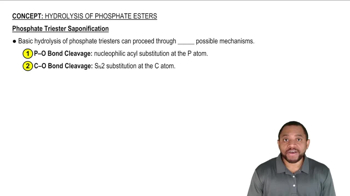
Hydrolysis of Phosphate Esters Concept 2

Acid Catalysis

Acid catalysis involves the use of an acid to increase the rate of a chemical reaction. In ester hydrolysis, the acid donates a proton (H+) to the carbonyl oxygen of the ester, enhancing its electrophilicity and making it more susceptible to nucleophilic attack by water. This mechanism is essential for facilitating the reaction under mild conditions.
추천 영상:
가이드 코스
2:50
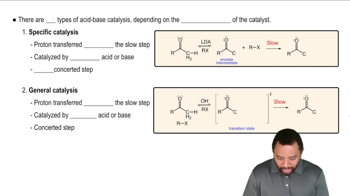
Acid-Base Catalysis Concept 3

Nucleophilic Attack

Nucleophilic attack is a fundamental concept in organic reactions where a nucleophile, a species with a high electron density, attacks an electrophile, a positively charged or electron-deficient species. In the case of ester hydrolysis, water acts as the nucleophile that attacks the carbonyl carbon of the activated ester, leading to the formation of the alcohol and carboxylic acid products.
추천 영상:
08:27
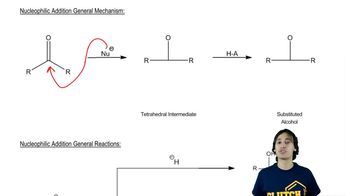
Nucleophilic Addition