Ch. 21 - Carboxylic Acid Derivatives
Wade - Organic Chemistry 9th Edition
Wade9th EditionOrganic ChemistryISBN: 9780135213728당신이 사용하는 게 아니라요?교과서 변경
21장, 문제 49f

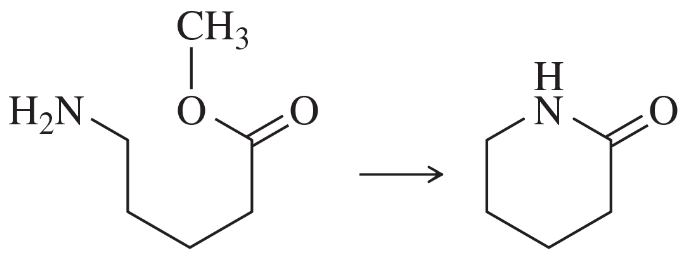
Propose mechanisms for the following reactions.
(f)

검증된 단계별 안내
1
Step 1: Analyze the reactant and product structures. The reactant is an amino ester (contains an amine group and an ester functional group), and the product is a lactam (a cyclic amide). This suggests that the reaction involves intramolecular nucleophilic attack and cyclization.
Step 2: Identify the nucleophile and electrophile. The amine group (-NH2) in the reactant acts as the nucleophile, while the carbonyl carbon of the ester group is the electrophile. The lone pair on the nitrogen can attack the carbonyl carbon.
Step 3: Propose the mechanism for nucleophilic attack. The nitrogen's lone pair attacks the carbonyl carbon of the ester, forming a tetrahedral intermediate. This intermediate is stabilized by the oxygen atom of the ester group.
Step 4: Describe the elimination step. The tetrahedral intermediate undergoes elimination of the methoxy group (-OCH3), leading to the formation of the cyclic amide (lactam). This step involves breaking the C-O bond and forming the C-N bond.
Step 5: Confirm the final product. The reaction results in the formation of a six-membered lactam ring, which is consistent with the product shown in the image. The mechanism involves intramolecular cyclization and substitution.

비슷한 문제에 대한 검증된 영상 답변:

이 영상 해법은 위 문제에 도움이 된다고 튜터들이 추천한 것입니다.
영상 길이:
1m

주요 개념

질문에 올바르게 답하기 위해 반드시 이해해야 하는 핵심 개념들은 다음과 같습니다.

Nucleophilic Acyl Substitution

Nucleophilic acyl substitution is a fundamental reaction mechanism in organic chemistry where a nucleophile attacks an electrophilic carbonyl carbon, leading to the substitution of a leaving group. In the context of the reaction shown, the amine acts as the nucleophile, attacking the carbonyl carbon of the ester, which facilitates the formation of a new bond and the release of an alcohol.
추천 영상:
01:47
Nucleophiles and Electrophiles can react in Substitution Reactions.

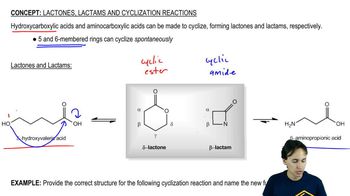
Lactam Formation

Lactams are cyclic amides formed from the reaction of an amine with a carbonyl compound, typically involving a ring closure. In this reaction, the nucleophilic attack by the amine on the carbonyl carbon of the ester leads to the formation of a cyclic structure, resulting in a lactam. Understanding the conditions that favor lactam formation, such as the stability of the cyclic structure, is crucial for predicting the outcome of the reaction.
추천 영상:
05:19
Lactones and Lactams

Reaction Mechanism Steps

A reaction mechanism outlines the step-by-step process by which reactants are converted into products. For the transformation depicted, the mechanism would include the nucleophilic attack, the formation of a tetrahedral intermediate, and the subsequent elimination of the leaving group, leading to the formation of the lactam. Analyzing each step helps in understanding the overall reaction dynamics and the factors influencing the reaction pathway.
추천 영상:
가이드 코스
3:05
Polyurethane Mechanism Example 1