Propose a mechanism for the reaction of methyl isocyanate with 1-naphthol to give Sevin® insecticide.
Ch. 21 - Carboxylic Acid Derivatives
21장, 문제 39c
Show how each transformation may be accomplished by using a nitrile as an intermediate. You may use any necessary reagents.
(c) octan-1-ol → decan-2-one
검증된 단계별 안내1
Identify the target transformation: The goal is to convert octan-1-ol (an alcohol) into decan-2-one (a ketone). This involves chain elongation by two carbons and functional group transformation.
Convert octan-1-ol into a nitrile intermediate: First, oxidize octan-1-ol to octanal (an aldehyde) using an oxidizing agent like PCC (Pyridinium chlorochromate). Then, perform a nucleophilic addition of HCN (hydrogen cyanide) to the aldehyde to form octanenitrile.
Elongate the carbon chain of the nitrile: React octanenitrile with a Grignard reagent, such as ethylmagnesium bromide (CH₃CH₂MgBr). This step adds two carbons to the chain and forms an imine intermediate.
Hydrolyze the imine intermediate: Treat the imine with aqueous acid (H₃O⁺) to hydrolyze it into decan-2-one, completing the transformation.
Verify the product: Confirm that the final product is decan-2-one, a ketone with a 10-carbon chain and the carbonyl group on the second carbon.

비슷한 문제에 대한 검증된 영상 답변:
이 영상 해법은 위 문제에 도움이 된다고 튜터들이 추천한 것입니다.
영상 길이:
3m도움이 되었나요?
주요 개념
질문에 올바르게 답하기 위해 반드시 이해해야 하는 핵심 개념들은 다음과 같습니다.
Nitrile Chemistry
Nitriles are organic compounds containing a cyano group (-C≡N). They can be used as versatile intermediates in organic synthesis, allowing for the formation of various functional groups. In the context of the transformation from octan-1-ol to decan-2-one, nitriles can be formed through the reaction of alcohols with reagents like thionyl chloride or phosphorus pentachloride, followed by nucleophilic addition reactions.
추천 영상:
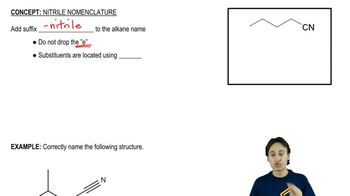
Nitrile Nomenclature
Reduction Reactions
Reduction reactions involve the gain of electrons or the decrease in oxidation state of a molecule. In organic chemistry, nitriles can be reduced to primary amines or aldehydes using reducing agents such as lithium aluminum hydride (LiAlH4) or hydrogen gas in the presence of a catalyst. Understanding these reduction pathways is crucial for manipulating nitriles to achieve desired carbonyl compounds like decan-2-one.
추천 영상:
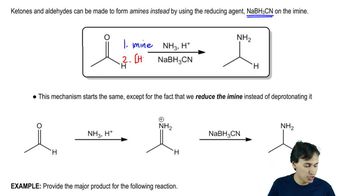
Reductive Amination
Carbon Chain Lengthening
Carbon chain lengthening is a synthetic strategy used to increase the number of carbon atoms in a molecule. This can be achieved through various methods, including the use of nitriles as intermediates. In the transformation from octan-1-ol to decan-2-one, a key step may involve the formation of a longer-chain nitrile, followed by hydrolysis and subsequent reduction to yield the desired ketone, demonstrating the utility of nitriles in building complex organic structures.
추천 영상:
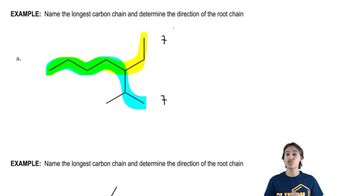
Name the longest carbon chain
관련 실천
교과서 질문
188
views
교과서 질문
Show how each transformation may be accomplished by using a nitrile as an intermediate. You may use any necessary reagents.
(b) cyclohexanecarboxamide → cyclohexyl ethyl ketone
737
views
교과서 질문
For each heterocyclic compound,
(iii) are any of the rings aromatic? Explain.
(a)
(b)
(c)
1281
views
교과서 질문
For each heterocyclic compound,
(ii) show what compounds would result from complete hydrolysis.
(a)
(b)
(c)
1061
views
교과서 질문
Show how each transformation may be accomplished by using a nitrile as an intermediate. You may use any necessary reagents.
(a) hexan-1-ol → heptan-1-amine
930
views
교과서 질문
Show how you would convert the following starting materials to the indicated nitriles:
(c) p-chloronitrobenzene → p-chlorobenzonitrile
555
views