

Ch. 21 - Carboxylic Acid Derivatives
Wade - Organic Chemistry 9th Edition
Wade9th EditionOrganic ChemistryISBN: 9780135213728당신이 사용하는 게 아니라요?교과서 변경
21장, 문제 38c

Show how you would convert the following starting materials to the indicated nitriles:
(c) p-chloronitrobenzene → p-chlorobenzonitrile

검증된 단계별 안내
1
Identify the functional group transformation: The problem requires converting a nitro group (-NO₂) on p-chloronitrobenzene to a nitrile group (-CN) while retaining the chlorine substituent on the benzene ring.
Recognize the reaction type: This transformation involves a two-step process. First, the nitro group (-NO₂) is reduced to an amine group (-NH₂). Then, the amine group is converted to a nitrile group (-CN) via a Sandmeyer reaction.
Step 1: Reduction of the nitro group to an amine group. Use a reducing agent such as Sn/HCl or Fe/HCl to reduce the nitro group (-NO₂) on p-chloronitrobenzene to an amine group (-NH₂), forming p-chloroaniline.
Step 2: Diazotization of the amine group. Treat p-chloroaniline with sodium nitrite (NaNO₂) and hydrochloric acid (HCl) at 0–5°C to form the diazonium salt intermediate, p-chlorobenzenediazonium chloride.
Step 3: Sandmeyer reaction to introduce the nitrile group. React the diazonium salt with copper(I) cyanide (CuCN) to replace the diazonium group (-N₂⁺) with a nitrile group (-CN), yielding p-chlorobenzonitrile as the final product.

비슷한 문제에 대한 검증된 영상 답변:

이 영상 해법은 위 문제에 도움이 된다고 튜터들이 추천한 것입니다.
영상 길이:
3m

주요 개념

질문에 올바르게 답하기 위해 반드시 이해해야 하는 핵심 개념들은 다음과 같습니다.

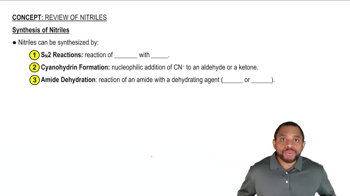
Nitrile Synthesis

Nitriles can be synthesized from various organic compounds through different methods, including the reaction of halides with sodium cyanide or the dehydration of amides. In this case, converting p-chloronitrobenzene to p-chlorobenzonitrile involves a nucleophilic substitution reaction where the nitro group is replaced by a cyano group.
추천 영상:
가이드 코스
0:59
Review of Nitriles Concept 1

Nucleophilic Substitution

Nucleophilic substitution is a fundamental reaction in organic chemistry where a nucleophile attacks an electrophilic carbon atom, leading to the replacement of a leaving group. In the conversion of p-chloronitrobenzene to p-chlorobenzonitrile, the nucleophile (cyanide ion) replaces the chlorine atom, demonstrating this key reaction mechanism.
추천 영상:
01:47
Nucleophiles and Electrophiles can react in Substitution Reactions.

Electrophilic Aromatic Substitution

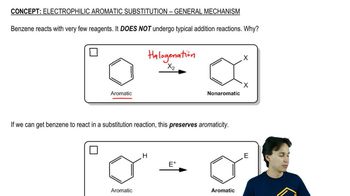
Electrophilic aromatic substitution (EAS) is a reaction where an electrophile replaces a hydrogen atom on an aromatic ring. In the context of p-chloronitrobenzene, the presence of the nitro group activates the ring towards further substitution, allowing for the introduction of the cyano group in the desired position, which is crucial for achieving the final product.
추천 영상:
03:07
EAS Review