
Ch. 21 - Carboxylic Acid Derivatives
Wade - Organic Chemistry 9th Edition
Wade9th EditionOrganic ChemistryISBN: 9780135213728당신이 사용하는 게 아니라요?교과서 변경
21장, 문제 36a,b

Show how you would accomplish the following synthetic transformations. You may use any necessary reagents.
(a) N-ethylbenzamide → benzylethylamine
(b) ethyl benzoate → N-ethylbenzamide

검증된 단계별 안내
1
Step 1 (a): To convert N-ethylbenzamide to benzylethylamine, first identify the functional group transformation. This involves reducing the amide group (-CONH-) to an amine (-NH-). Use a reducing agent such as lithium aluminum hydride (LiAlH4) in an appropriate solvent like ether to achieve this reduction.
Step 2 (a): After the reduction, the product will be benzylethylamine, where the carbonyl group is removed, leaving a secondary amine attached to the benzyl group and ethyl group.
Step 1 (b): To convert ethyl benzoate to N-ethylbenzamide, first hydrolyze the ester group (-COOEt) to a carboxylic acid (-COOH). This can be done using aqueous acid (HCl) or base (NaOH) under reflux conditions.
Step 2 (b): Once the carboxylic acid is formed, react it with ethylamine (CH3CH2NH2) in the presence of a coupling agent such as dicyclohexylcarbodiimide (DCC) or use an acid chloride intermediate (benzoyl chloride) to form the amide bond.
Step 3 (b): The final product will be N-ethylbenzamide, where the ethyl group is attached to the nitrogen of the amide functional group.

비슷한 문제에 대한 검증된 영상 답변:

이 영상 해법은 위 문제에 도움이 된다고 튜터들이 추천한 것입니다.
영상 길이:
8m

주요 개념

질문에 올바르게 답하기 위해 반드시 이해해야 하는 핵심 개념들은 다음과 같습니다.

Amide Hydrolysis

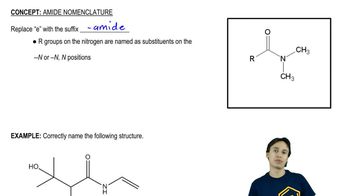
Amide hydrolysis is a reaction where an amide is converted into a carboxylic acid and an amine through the addition of water. This reaction can be catalyzed by either acid or base. In the context of the transformation from N-ethylbenzamide to benzylethylamine, hydrolysis can help in breaking down the amide bond, allowing for the formation of the desired amine.
추천 영상:
01:33
Amide Nomenclature

Friedel-Crafts Alkylation

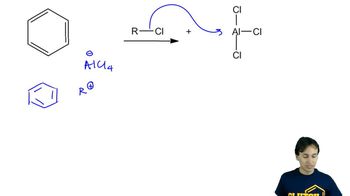
Friedel-Crafts alkylation is a method used to attach alkyl groups to aromatic rings using alkyl halides and a Lewis acid catalyst. This reaction is crucial for synthesizing benzylethylamine from N-ethylbenzamide, as it allows for the introduction of the ethyl group onto the benzene ring, facilitating the formation of the desired product.
추천 영상:
06:30
Friedel-Crafts Alkylation

Esterification and Transesterification

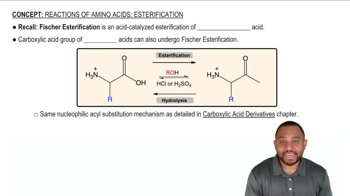
Esterification is the process of forming an ester from a carboxylic acid and an alcohol, while transesterification involves exchanging the alkoxy group of an ester with another alcohol. In the transformation from ethyl benzoate to N-ethylbenzamide, the reaction involves converting the ester into an amide, typically through the reaction with an amine, which is essential for achieving the desired synthetic pathway.
추천 영상:
가이드 코스
1:21
Reactions of Amino Acids: Esterification Concept 1