Ch. 23 - Carbohydrates and Nucleic Acids
Wade - Organic Chemistry 9th Edition
Wade9th EditionOrganic ChemistryISBN: 9780135213728당신이 사용하는 게 아니라요?교과서 변경
23장, 문제 62

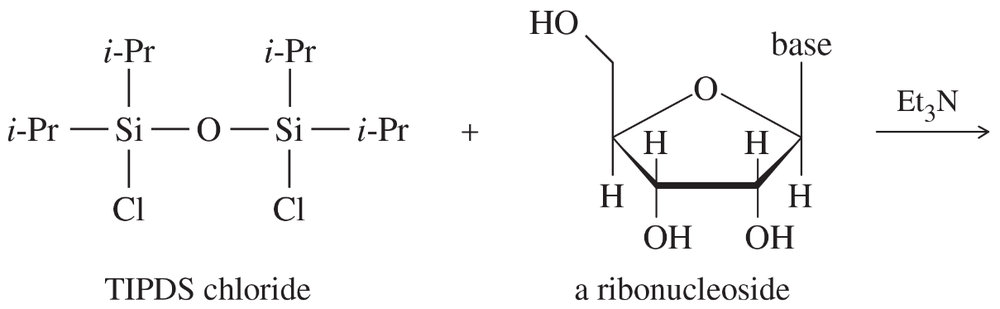
An important protecting group developed specifically for polyhydroxy compounds like nucleosides is the tetraisopropyldisiloxanyl group, abbreviated TIPDS, that can protect two alcohol groups in a molecule.

(a) The TIPDS group is somewhat hindered around the Si atoms by the isopropyl groups. Which OH is more likely to react first with TIPDS chloride? Show the product with the TIPDS group on one oxygen.
(b) Once the TIPDS group is attached at the first oxygen, it reaches around to the next closest oxygen. Show the final product with two oxygens protected.
(c) The unprotected hydroxy group can now undergo reactions without affecting the protected oxygens. Show the product after the protected nucleoside from (b) is treated with tosyl chloride and pyridine, followed by NaBr, ending with deprotection with Bu4NF.

검증된 단계별 안내
1
Step 1: Analyze the structure of TIPDS chloride and the nucleoside. TIPDS chloride contains two reactive Si-Cl bonds, and the nucleoside has multiple hydroxyl (-OH) groups. The steric hindrance around the Si atoms due to the isopropyl groups makes TIPDS chloride selective in its reaction with hydroxyl groups.
Step 2: Identify the hydroxyl group most likely to react first. The hydroxyl group at the 5' position (CH2OH) is less sterically hindered compared to the other hydroxyl groups on the nucleoside. This makes it the most likely candidate for the initial reaction with TIPDS chloride.
Step 3: Show the product after the first reaction. The TIPDS group will attach to the 5' hydroxyl group, forming a silyl ether bond. The structure will now have the TIPDS group protecting the 5' oxygen.
Step 4: Consider the second reaction. Once the TIPDS group is attached to the first oxygen, it can reach around to the next closest hydroxyl group due to its flexible Si-O bond. The 3' hydroxyl group is the next closest and will react to form a second silyl ether bond, resulting in both the 5' and 3' oxygens being protected by the TIPDS group.
Step 5: Address the final part of the problem. The unprotected hydroxyl group (likely at the 2' position) can now undergo reactions. Treating the protected nucleoside with tosyl chloride and pyridine will convert the unprotected hydroxyl group into a tosylate. Subsequent reaction with NaBr will replace the tosyl group with a bromine atom. Finally, deprotection with Bu4NF will remove the TIPDS group, restoring the original hydroxyl groups at the 5' and 3' positions.

비슷한 문제에 대한 검증된 영상 답변:

이 영상 해법은 위 문제에 도움이 된다고 튜터들이 추천한 것입니다.
영상 길이:
14m
도움이 되었나요?

주요 개념

질문에 올바르게 답하기 위해 반드시 이해해야 하는 핵심 개념들은 다음과 같습니다.

Protecting Groups in Organic Chemistry

Protecting groups are temporary modifications used to shield reactive functional groups during chemical reactions. In the context of polyhydroxy compounds, such as nucleosides, protecting groups like the tetraisopropyldisiloxanyl (TIPDS) group prevent unwanted reactions at hydroxyl (-OH) sites, allowing for selective functionalization of other parts of the molecule.
추천 영상:
02:44
Protecting Groups

Reactivity of Alcohols

Alcohols are characterized by their hydroxyl (-OH) groups, which can act as nucleophiles in chemical reactions. The reactivity of alcohols can vary based on steric hindrance and electronic effects. In the case of TIPDS protection, the steric bulk of the isopropyl groups around the silicon atoms influences which hydroxyl group will react first with TIPDS chloride, typically favoring the less hindered alcohol.
추천 영상:
01:01
How to name alcohols

Deprotection Strategies

Deprotection is the process of removing a protecting group to restore the original functional group. In this scenario, after the nucleoside is treated with tosyl chloride and pyridine, the protected hydroxyl groups remain intact while the unprotected hydroxyl can undergo further reactions. The final step involves using Bu4NF to selectively remove the TIPDS group, allowing for the desired functionalization of the nucleoside.
추천 영상:
05:49
Mechanism of t-Butyl Ether Protecting Groups.
관련 실천
교과서 질문

Draw the structures of the following nucleotides.

(c) cyclic guanosine monophosphate (cGMP)

795
views

교과서 질문

Some protecting groups can block two OH groups of a carbohydrate at the same time. One such group is shown here, protecting the 4-OH and 6-OH groups of β-d-glucose.

(a) What type of functional group is involved in this blocking group?

(b) What did glucose react with to form this protected compound?

(c) When this blocking group is added to glucose, a new chiral center is formed. Where is it? Draw the stereoisomer that has the other configuration at this chiral center. What is the relationship between these two stereoisomers of the protected compound?

(d) Which of the two stereoisomers in part (c) do you expect to be the major product? Why?

1667
views
교과서 질문

Draw the structures of the following nucleotides.

(a) guanosine triphosphate (GTP)

885
views
교과서 질문

When the gum of the shrub Sterculia setigera is subjected to acidic hydrolysis, one of the water-soluble components of the hydrolysate is found to be tagatose. The following information is known about tagatose:

(1) Molecular formula C6H12O6

(2) Undergoes mutarotation.

(3) Does not react with bromine water.

(4) Reduces Tollens reagent to give D-galactonic acid and D-talonic acid.

(5) Methylation of tagatose (using excess CH3I and Ag2O) followed by acidic hydrolysis gives 1,3,4,5-tetra-O-methyltagatose.

(a) Draw a Fischer projection structure for the open-chain form of tagatose.

935
views
교과서 질문

Draw the structures of the following nucleotides.

(b) deoxycytidine monophosphate (dCMP)

939
views
교과서 질문

Show what product results if the aldopentose formed from degradation of X is further degraded to an aldotetrose. Does HNO3 oxidize this aldotetrose to an optically active aldaric acid?

898
views