Ch. 23 - Carbohydrates and Nucleic Acids
Wade - Organic Chemistry 9th Edition
Wade9th EditionOrganic ChemistryISBN: 9780135213728당신이 사용하는 게 아니라요?교과서 변경
23장, 문제 63b

Draw the structures of the following nucleotides.
(b) deoxycytidine monophosphate (dCMP)

검증된 단계별 안내
1
Understand the structure of a nucleotide: A nucleotide consists of three components: a nitrogenous base, a sugar, and a phosphate group. For deoxycytidine monophosphate (dCMP), the nitrogenous base is cytosine, the sugar is deoxyribose, and there is one phosphate group attached.
Identify the nitrogenous base: Cytosine is a pyrimidine base with a single six-membered ring containing nitrogen atoms. Its structure includes an amine group (-NH2) at position 4 and a keto group (=O) at position 2.
Determine the sugar: Deoxyribose is a five-carbon sugar (pentose) with the formula C₅H₁₀O₄. It differs from ribose by lacking a hydroxyl group (-OH) at the 2' carbon, having only a hydrogen atom there instead.
Connect the base to the sugar: The cytosine base is attached to the 1' carbon of the deoxyribose sugar via a β-N-glycosidic bond. This bond forms between the nitrogen at position 1 of cytosine and the 1' carbon of deoxyribose.
Add the phosphate group: The phosphate group is attached to the 5' carbon of the deoxyribose sugar via a phosphoester bond. This completes the structure of deoxycytidine monophosphate (dCMP).

비슷한 문제에 대한 검증된 영상 답변:

이 영상 해법은 위 문제에 도움이 된다고 튜터들이 추천한 것입니다.
영상 길이:
6m

주요 개념

질문에 올바르게 답하기 위해 반드시 이해해야 하는 핵심 개념들은 다음과 같습니다.

Nucleotide Structure

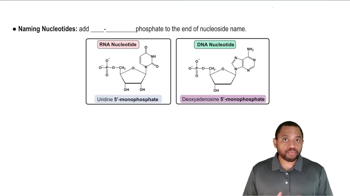
Nucleotides are the building blocks of nucleic acids, consisting of three components: a nitrogenous base, a five-carbon sugar, and one or more phosphate groups. In the case of deoxycytidine monophosphate (dCMP), the nitrogenous base is cytosine, the sugar is deoxyribose, and there is one phosphate group attached. Understanding this structure is essential for drawing the correct molecular representation.
추천 영상:
가이드 코스
1:21
Naming Nucleosides and Nucleotides Concept 2

Deoxyribose Sugar

Deoxyribose is a five-carbon sugar that differs from ribose by the absence of one oxygen atom at the 2' position. This structural difference is crucial in distinguishing DNA from RNA, as deoxyribonucleotides (like dCMP) contain deoxyribose, while ribonucleotides contain ribose. Recognizing the sugar's structure helps in accurately depicting nucleotides.
추천 영상:
08:42
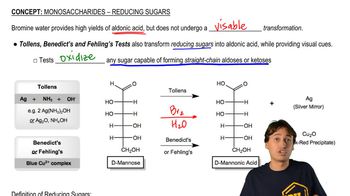
Reducing Sugars

Phosphate Group Attachment

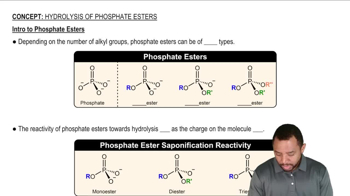
In nucleotides, the phosphate group is typically attached to the 5' carbon of the sugar. For dCMP, this attachment is vital for its role in forming nucleic acid chains. Understanding how the phosphate group connects to the sugar and the nitrogenous base is key to accurately representing the nucleotide's structure and its function in biological systems.
추천 영상:
가이드 코스
1:47
Hydrolysis of Phosphate Esters Concept 1
관련 실천
교과서 질문

Draw the structures of the following nucleotides.

(c) cyclic guanosine monophosphate (cGMP)

795
views

교과서 질문

Some protecting groups can block two OH groups of a carbohydrate at the same time. One such group is shown here, protecting the 4-OH and 6-OH groups of β-d-glucose.

(a) What type of functional group is involved in this blocking group?

(b) What did glucose react with to form this protected compound?

(c) When this blocking group is added to glucose, a new chiral center is formed. Where is it? Draw the stereoisomer that has the other configuration at this chiral center. What is the relationship between these two stereoisomers of the protected compound?

(d) Which of the two stereoisomers in part (c) do you expect to be the major product? Why?

1668
views
교과서 질문

Draw the structures of the following nucleotides.

(a) guanosine triphosphate (GTP)

885
views
교과서 질문

Draw the structure of a four-residue segment of DNA with the following sequence. (3′end) G-T-A-C (5′ end)

107
views
교과서 질문

An important protecting group developed specifically for polyhydroxy compounds like nucleosides is the tetraisopropyldisiloxanyl group, abbreviated TIPDS, that can protect two alcohol groups in a molecule.

(a) The TIPDS group is somewhat hindered around the Si atoms by the isopropyl groups. Which OH is more likely to react first with TIPDS chloride? Show the product with the TIPDS group on one oxygen.

(b) Once the TIPDS group is attached at the first oxygen, it reaches around to the next closest oxygen. Show the final product with two oxygens protected.

(c) The unprotected hydroxy group can now undergo reactions without affecting the protected oxygens. Show the product after the protected nucleoside from (b) is treated with tosyl chloride and pyridine, followed by NaBr, ending with deprotection with Bu4NF.

1940
views