Ch.4 - The Study of Chemical Reactions
Wade - Organic Chemistry 9th Edition
Wade9th EditionOrganic ChemistryISBN: 9780135213728당신이 사용하는 게 아니라요?교과서 변경
4장, 문제 47e

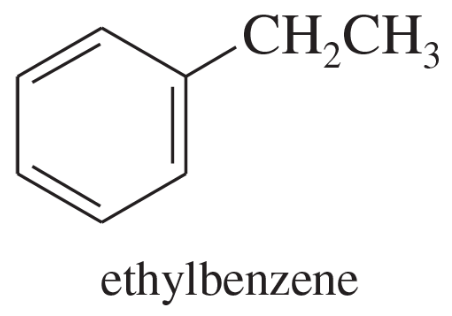
For each compound, predict the major product of free-radical bromination. Remember that bromination is highly selective, and only the most stable radical will be formed.
(e)

검증된 단계별 안내
1
Step 1: Recognize that the problem involves free-radical bromination, which is highly selective and favors the formation of the most stable radical intermediate. Bromine reacts preferentially at the position that forms the most stable radical.
Step 2: Analyze the structure of ethylbenzene. It consists of a benzene ring attached to an ethyl group (CH2CH3). The ethyl group has two types of hydrogens: the benzylic hydrogens (on the CH2 group) and the hydrogens on the CH3 group.
Step 3: Determine the stability of the radicals formed by removing a hydrogen atom from each position. Removing a benzylic hydrogen (from CH2) forms a benzylic radical, which is highly stabilized due to resonance with the benzene ring. Removing a hydrogen from the CH3 group forms a primary radical, which is less stable.
Step 4: Conclude that bromination will occur at the benzylic position (CH2 group) because the benzylic radical is the most stable intermediate. Bromine will replace one of the hydrogens on the CH2 group.
Step 5: The major product of free-radical bromination of ethylbenzene will be bromine attached to the benzylic position, resulting in 1-bromo-2-phenylethane.

비슷한 문제에 대한 검증된 영상 답변:

이 영상 해법은 위 문제에 도움이 된다고 튜터들이 추천한 것입니다.
영상 길이:
3m

주요 개념

질문에 올바르게 답하기 위해 반드시 이해해야 하는 핵심 개념들은 다음과 같습니다.

Free-Radical Bromination

Free-radical bromination is a reaction where bromine (Br2) reacts with alkanes or alkenes in the presence of heat or light to form brominated products. This process involves the formation of bromine radicals, which abstract hydrogen atoms from the substrate, leading to the generation of carbon-centered radicals. The stability of these radicals influences the selectivity of the reaction, favoring the formation of the most stable radical intermediate.
추천 영상:
05:20
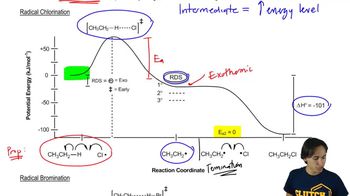
Using the Hammond Postulate to describe radical bromination.

Radical Stability

The stability of radicals is a key factor in determining the major product of free-radical bromination. Radicals are more stable when they are tertiary (attached to three carbon atoms), followed by secondary (two carbon atoms), and then primary (one carbon atom). This stability hierarchy arises from hyperconjugation and the inductive effect, which help to delocalize the unpaired electron, making the radical less reactive and more stable.
추천 영상:
03:43
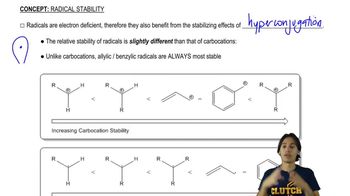
The radical stability trend.

Selectivity in Bromination

Bromination is known for its selectivity, meaning it preferentially reacts with the most stable radical formed during the reaction. This selectivity is due to the energy barrier associated with forming different radicals; more stable radicals require less energy to form and are thus favored. In the case of ethylbenzene, the presence of the ethyl group can influence the stability of the radical formed, leading to specific products based on the structure of the substrate.
추천 영상:
00:54
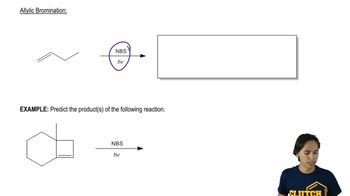
Mechanism of Allylic Bromination.
관련 실천
교과서 질문

For each compound, predict the major product of free-radical bromination. Remember that bromination is highly selective, and only the most stable radical will be formed.

(a) cyclohexane

(b) methylcyclopentane

2161
views

교과서 질문

When exactly 1 mole of methane is mixed with exactly 1 mole of chlorine and light is shone on the mixture, a ­chlorination reaction occurs. The products are found to contain substantial amounts of di-, tri-, and tetrachloromethane, as well as ­unreacted methane.

a. Explain how a mixture is formed from this stoichiometric mixture of reactants, and propose mechanisms for the ­formation of these compounds from chloromethane.

2049
views
교과서 질문

In the presence of a small amount of bromine, the following light-promoted reaction has been observed.

a. Write a mechanism for this reaction. Your mechanism should explain how both products are formed. (Hint: Notice which H atom has been lost in both products.)

865
views
교과서 질문

In the presence of a small amount of bromine, the following light-promoted reaction has been observed.

b. Explain why only this one type of hydrogen atom has been replaced, in preference to any of the other hydrogen atoms in the starting material.

627
views
교과서 질문

For each compound, predict the major product of free-radical bromination. Remember that bromination is highly selective, and only the most stable radical will be formed.

(f)

788
views
교과서 질문

When exactly 1 mole of methane is mixed with exactly 1 mole of chlorine and light is shone on the mixture, a ­chlorination reaction occurs. The products are found to contain substantial amounts of di-, tri-, and tetrachloromethane, as well as ­unreacted methane.

b. How would you run this reaction to get a good conversion of methane to CH3Cl? Of methane to CCl4?

841
views