Ch.4 - The Study of Chemical Reactions
Wade - Organic Chemistry 9th Edition
Wade9th EditionOrganic ChemistryISBN: 9780135213728당신이 사용하는 게 아니라요?교과서 변경
4장, 문제 48b

When exactly 1 mole of methane is mixed with exactly 1 mole of chlorine and light is shone on the mixture, a ­chlorination reaction occurs. The products are found to contain substantial amounts of di-, tri-, and tetrachloromethane, as well as ­unreacted methane.
b. How would you run this reaction to get a good conversion of methane to CH3Cl? Of methane to CCl4?

검증된 단계별 안내
1
Understand the reaction: The chlorination of methane is a free radical substitution reaction that occurs in the presence of light (UV radiation). Chlorine radicals are generated, which react with methane to form chlorinated products such as CH3Cl, CH2Cl2, CHCl3, and CCl4.
To maximize the conversion of methane to CH3Cl (monochloromethane), limit the amount of chlorine relative to methane. Use an excess of methane to reduce the likelihood of further substitution reactions that produce di-, tri-, and tetrachlorinated products.
To maximize the conversion of methane to CCl4 (tetrachloromethane), use an excess of chlorine relative to methane. This ensures that multiple substitution reactions can occur, replacing all hydrogen atoms in methane with chlorine atoms.
Control the reaction conditions: For selective production of CH3Cl, carefully monitor the reaction time and stop the reaction early to prevent further substitution. For CCl4, allow the reaction to proceed to completion under excess chlorine conditions.
Use appropriate separation techniques: After the reaction, separate the desired product (CH3Cl or CCl4) from the reaction mixture using methods such as distillation, as the products have different boiling points.

비슷한 문제에 대한 검증된 영상 답변:

이 영상 해법은 위 문제에 도움이 된다고 튜터들이 추천한 것입니다.
영상 길이:
5m

주요 개념

질문에 올바르게 답하기 위해 반드시 이해해야 하는 핵심 개념들은 다음과 같습니다.

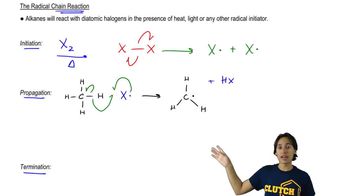
Free Radical Halogenation

Free radical halogenation is a reaction mechanism where alkanes react with halogens in the presence of light or heat, leading to the formation of free radicals. This process involves the initiation, propagation, and termination steps, resulting in the substitution of hydrogen atoms in the alkane with halogen atoms. Understanding this mechanism is crucial for predicting the products formed during the chlorination of methane.
추천 영상:
12:11
Radical Chain Reaction Mechanism.

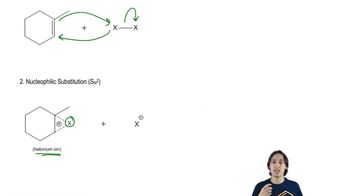
Selectivity in Halogenation

Selectivity in halogenation refers to the preference of a halogen to substitute certain hydrogen atoms over others in a hydrocarbon. In the case of methane, the formation of chlorinated products like CH3Cl, CH2Cl2, and CCl4 depends on the reaction conditions, such as the concentration of chlorine and the duration of light exposure. Recognizing how to manipulate these factors can help achieve a desired product distribution.
추천 영상:
03:45
Halogenation Mechanism

Reaction Conditions

The reaction conditions, including temperature, light intensity, and the ratio of reactants, significantly influence the outcome of the chlorination reaction. For example, to favor the formation of CH3Cl, a lower concentration of chlorine and shorter reaction time are beneficial, while higher concentrations and longer exposure can lead to more chlorinated products like CCl4. Adjusting these conditions is essential for optimizing product yields.
추천 영상:
가이드 코스
1:18
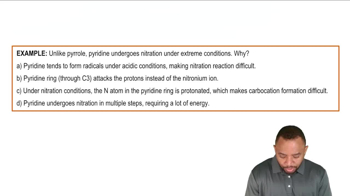
EAS Reactions of Pyridine Example 1
관련 실천
교과서 질문

For each compound, predict the major product of free-radical bromination. Remember that bromination is highly selective, and only the most stable radical will be formed.

(e)

1449
views

교과서 질문

The chlorination of pentane gives a mixture of three monochlorinated products.

b. Predict the ratios in which these monochlorination products will be formed, remembering that a chlorine atom abstracts a secondary hydrogen about 4.5 times as fast as it abstracts a primary hydrogen.

1908
views
교과서 질문

The chlorination of pentane gives a mixture of three monochlorinated products.

a. Draw their structures.

2466
views
교과서 질문

When exactly 1 mole of methane is mixed with exactly 1 mole of chlorine and light is shone on the mixture, a ­chlorination reaction occurs. The products are found to contain substantial amounts of di-, tri-, and tetrachloromethane, as well as ­unreacted methane.

a. Explain how a mixture is formed from this stoichiometric mixture of reactants, and propose mechanisms for the ­formation of these compounds from chloromethane.

2049
views
교과서 질문

a. Draw the structure of the transition state for the second propagation step in the chlorination of methane.

Show whether the transition state is product-like or reactant-like and which of the two partial bonds is stronger.

1113
views
교과서 질문

For each compound, predict the major product of free-radical bromination. Remember that bromination is highly selective, and only the most stable radical will be formed.

(f)

788
views