Ch.5 - Stereochemistry
Wade - Organic Chemistry 9th Edition
Wade9th EditionOrganic ChemistryISBN: 9780135213728당신이 사용하는 게 아니라요?교과서 변경
5장, 문제 10

A chiral sample gives a rotation that is close to 180°. How can one tell whether this rotation is +180° or -180°?

검증된 단계별 안내
1
Understand that optical rotation is a property of chiral compounds, and it is measured using a polarimeter. The rotation can be either clockwise (denoted as +) or counterclockwise (denoted as -).
Recall that the sign of the rotation (+ or -) is determined by the direction in which the plane of polarized light is rotated when it passes through the chiral sample.
To determine whether the rotation is +180° or -180°, observe the direction of rotation of the plane of polarized light. If the light rotates clockwise, the rotation is +180°. If it rotates counterclockwise, the rotation is -180°.
Use the polarimeter to carefully observe the direction of rotation. The polarimeter will indicate whether the rotation is positive or negative based on the direction of the observed rotation.
Ensure that the measurement is taken under standard conditions (e.g., specific wavelength of light, temperature, and concentration of the sample) to avoid any ambiguity in determining the sign of the rotation.

비슷한 문제에 대한 검증된 영상 답변:

이 영상 해법은 위 문제에 도움이 된다고 튜터들이 추천한 것입니다.
영상 길이:
1m

주요 개념

질문에 올바르게 답하기 위해 반드시 이해해야 하는 핵심 개념들은 다음과 같습니다.

Chirality

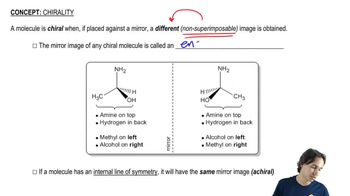
Chirality refers to the geometric property of a molecule that makes it non-superimposable on its mirror image. Chiral molecules typically have a carbon atom bonded to four different substituents, leading to two distinct enantiomers. These enantiomers can rotate plane-polarized light in opposite directions, which is a key characteristic used to distinguish them.
추천 영상:
05:10
What is chirality?

Optical Activity

Optical activity is the ability of chiral substances to rotate the plane of polarized light. The direction and degree of this rotation are measured in degrees, with positive values indicating clockwise rotation (+) and negative values indicating counterclockwise rotation (-). The specific rotation can be influenced by factors such as concentration and path length, making it essential to control these variables during measurement.
추천 영상:
08:17
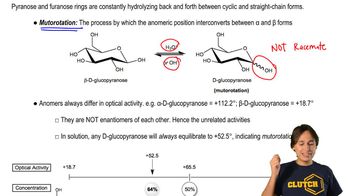
Mutorotation and Optical Activity

Polarimeter

A polarimeter is an instrument used to measure the angle of rotation of polarized light as it passes through a chiral sample. By analyzing the rotation, one can determine whether the sample is a specific enantiomer. The readings from a polarimeter can indicate whether the rotation is +180° or -180°, allowing chemists to identify the configuration of the chiral compound.
추천 영상:
05:43
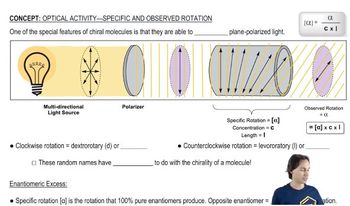
Specific rotation vs. observed rotation.
관련 실천
교과서 질문
Write structural formulas for the following compounds (includes both old- and new-style names). (j) vinylacetylene (k) (S)-3-methyl-1-penten-4-yne
1029
views

교과서 질문

A chemist finds that the addition of (+)-epinephrine to the catalytic reduction of butan-2-one (Figure 5-17 ) gives a product that is slightly optically active, with a specific rotation of +0.45°. Calculate the percentages of (+)-butan-2-ol and (−)-butan-2-ol formed in this reaction.

1637
views
교과서 질문

When optically pure (R)-2-bromobutane is heated with water, butan-2-ol is the product. The reaction forms twice as much (S)-butan-2-ol as (R)-butan-2-ol. Calculate the e.e. and the specific rotation expected for the product.

1199
views
교과서 질문

A solution of 2.0 g of (+)-glyceraldehyde, HOCH2CHOHCHO, in 10.0 mL of water was placed in a 100-mm cell. Using the sodium D line, a rotation of +1.74° was found at 25 °C. Determine the specific rotation of (+)-glyceraldehyde

2047
views
1
rank
교과서 질문

If you had the two enantiomers of carvone in unmarked bottles, could you use just your nose and a polarimeter to determine

a. whether it is the (+) or (−) enantiomer that smells like spearmint

b. whether it is the (R) or (S) enantiomer that smells like spearmint?

c. With the information given in the drawings of carvone above, what can you add to your answers to (a) and (b)?

2573
views
교과서 질문

A solution of 0.50 g of (−)-epinephrine (see Figure 5-16) dissolved in 10.0 mL of dilute aqueous HCl was placed in a 20-cm polarimeter tube. Using the sodium D line, the rotation was found to be −5.1° at 25 °C. Determine the specific rotation of epinephrine.

<IMAGE>

1184
views