
Ch.5 - Stereochemistry
Wade - Organic Chemistry 9th Edition
Wade9th EditionOrganic ChemistryISBN: 9780135213728당신이 사용하는 게 아니라요?교과서 변경
5장, 문제 12

When optically pure (R)-2-bromobutane is heated with water, butan-2-ol is the product. The reaction forms twice as much (S)-butan-2-ol as (R)-butan-2-ol. Calculate the e.e. and the specific rotation expected for the product.

검증된 단계별 안내
1
Step 1: Understand the reaction mechanism. The reaction involves the substitution of the bromine atom in (R)-2-bromobutane with a hydroxyl group (-OH) from water, forming butan-2-ol. This is an SN1 reaction, which proceeds through a carbocation intermediate. The planar nature of the carbocation allows for attack by water from either side, leading to the formation of both (R)- and (S)-butan-2-ol.
Step 2: Analyze the product distribution. The problem states that twice as much (S)-butan-2-ol is formed compared to (R)-butan-2-ol. This means the ratio of (S)- to (R)-butan-2-ol is 2:1. Let the amount of (R)-butan-2-ol be x. Then, the amount of (S)-butan-2-ol is 2x, and the total product is x + 2x = 3x.
Step 3: Calculate the enantiomeric excess (e.e.). Enantiomeric excess is defined as the difference in the percentage of the two enantiomers divided by the total percentage, expressed as a percentage. Using the formula: \( e.e. = \frac{|[S] - [R]|}{[S] + [R]} \times 100 \), substitute the values \([S] = 2x\) and \([R] = x\).
Step 4: Determine the specific rotation of the product. The specific rotation of a mixture is given by \( [\alpha]_{mixture} = e.e. \times [\alpha]_{pure} \), where \([\alpha]_{pure}\) is the specific rotation of the pure enantiomer. Use the calculated e.e. from Step 3 and the specific rotation of pure (S)- or (R)-butan-2-ol (if provided or known) to find the specific rotation of the product mixture.
Step 5: Summarize the results. The enantiomeric excess (e.e.) and the specific rotation of the product mixture can now be determined using the above calculations. Ensure all units and values are consistent and clearly presented.

비슷한 문제에 대한 검증된 영상 답변:

이 영상 해법은 위 문제에 도움이 된다고 튜터들이 추천한 것입니다.
영상 길이:
2m

주요 개념

질문에 올바르게 답하기 위해 반드시 이해해야 하는 핵심 개념들은 다음과 같습니다.

Optical Activity and Enantiomers

Optical activity refers to the ability of chiral compounds to rotate plane-polarized light. Enantiomers are pairs of molecules that are non-superimposable mirror images of each other, such as (R)- and (S)-butan-2-ol. In this reaction, the formation of both enantiomers indicates that the product is a racemic mixture, which is crucial for calculating enantiomeric excess (e.e.) and specific rotation.
추천 영상:
08:17
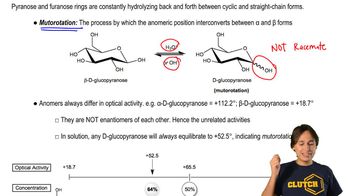
Mutorotation and Optical Activity

Enantiomeric Excess (e.e.)

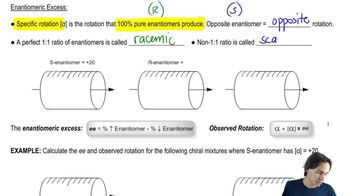
Enantiomeric excess (e.e.) is a measure of the purity of an enantiomer in a mixture, calculated as the absolute difference between the mole fractions of the two enantiomers. In this case, since twice as much (S)-butan-2-ol is produced compared to (R)-butan-2-ol, the e.e. can be determined by the formula e.e. = |(S) - (R)| / (S + R) × 100%, which quantifies the degree of chirality in the product.
추천 영상:
04:21
How to calculate enantiomeric excess.

Specific Rotation

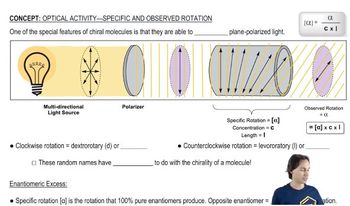
Specific rotation is a property of chiral compounds defined as the observed rotation of plane-polarized light at a specific concentration and path length. It is calculated using the formula [α] = α / (c × l), where α is the observed rotation, c is the concentration in g/mL, and l is the path length in decimeters. The specific rotation of the product can be determined by considering the contributions from both enantiomers based on their respective concentrations.
추천 영상:
05:43
Specific rotation vs. observed rotation.
관련 실천
교과서 질문
One of the crowning achievements of natural products synthesis was Bryostatin 1, published by Professor Gary Keck (University of Utah; Journal of the American Chemical Society, 2011, 133, 744–747). The Bryostatins are a family of compounds isolated from aquatic invertebrates known as Bryozoans. The compounds are of interest for a variety of biological effects, including anti-cancer activity and reversing brain damage in rodents. (d) How many chiral centers are in this molecule? (e) Using the number of chiral centers you reported in part (d), calculate the number of stereoisomers possible at these chiral centers. (Ignore stereoisomers at double bonds.)
499
views
교과서 질문

A chiral sample gives a rotation that is close to 180°. How can one tell whether this rotation is +180° or -180°?

2121
views
1
rank
교과서 질문

A chemist finds that the addition of (+)-epinephrine to the catalytic reduction of butan-2-one (Figure 5-17 ) gives a product that is slightly optically active, with a specific rotation of +0.45°. Calculate the percentages of (+)-butan-2-ol and (−)-butan-2-ol formed in this reaction.

1637
views
교과서 질문

If you had the two enantiomers of carvone in unmarked bottles, could you use just your nose and a polarimeter to determine

a. whether it is the (+) or (−) enantiomer that smells like spearmint

b. whether it is the (R) or (S) enantiomer that smells like spearmint?

c. With the information given in the drawings of carvone above, what can you add to your answers to (a) and (b)?

2573
views
교과서 질문

A solution of 0.50 g of (−)-epinephrine (see Figure 5-16) dissolved in 10.0 mL of dilute aqueous HCl was placed in a 20-cm polarimeter tube. Using the sodium D line, the rotation was found to be −5.1° at 25 °C. Determine the specific rotation of epinephrine.

<IMAGE>

1184
views
교과서 질문

Make a model of each compound, draw it in its most symmetric conformation, and determine whether it is capable of showing optical activity.

a. 1-bromo-1-chloroethane

b. 1-bromo-2-chloroethane

1591
views