
Ch.5 - Stereochemistry
Wade - Organic Chemistry 9th Edition
Wade9th EditionOrganic ChemistryISBN: 9780135213728당신이 사용하는 게 아니라요?교과서 변경
5장, 문제 3a,b

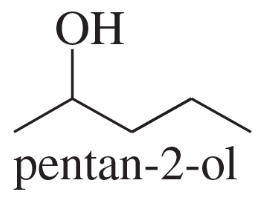
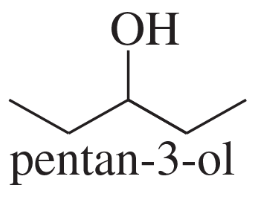
Draw a three-dimensional structure for each compound, and star all asymmetric carbon atoms. Draw the mirror for each structure, and state whether you have drawn a pair of enantiomers or just the same molecule twice. Build molecular models of any of these examples that seem difficult to you
(a)
(b)

검증된 단계별 안내
1
Step 1: Analyze the given structures for pentan-2-ol and pentan-3-ol. Pentan-2-ol has the hydroxyl group (-OH) attached to the second carbon in the chain, while pentan-3-ol has the hydroxyl group attached to the third carbon in the chain.
Step 2: Draw the three-dimensional structure for pentan-2-ol. Represent the carbon chain with tetrahedral geometry around each carbon atom. Use wedge and dash bonds to indicate the spatial arrangement of substituents. Identify the asymmetric carbon atom (a carbon bonded to four different groups) and mark it with a star.
Step 3: Draw the three-dimensional structure for pentan-3-ol. Similarly, represent the tetrahedral geometry and use wedge and dash bonds for spatial arrangement. Check for any asymmetric carbon atoms and mark them with a star.
Step 4: Draw the mirror image for each structure. Ensure that the mirror image reflects the spatial arrangement of the original molecule. Compare the original structure and its mirror image to determine if they are enantiomers (non-superimposable mirror images) or the same molecule.
Step 5: Build molecular models for pentan-2-ol and pentan-3-ol if needed. This will help visualize the three-dimensional arrangement and confirm the identification of asymmetric carbons and enantiomeric relationships.

비슷한 문제에 대한 검증된 영상 답변:

이 영상 해법은 위 문제에 도움이 된다고 튜터들이 추천한 것입니다.
영상 길이:
6m
도움이 되었나요?

주요 개념

질문에 올바르게 답하기 위해 반드시 이해해야 하는 핵심 개념들은 다음과 같습니다.

Asymmetric Carbon Atoms

Asymmetric carbon atoms, or chiral centers, are carbon atoms that are bonded to four different substituents. This unique arrangement allows for the existence of stereoisomers, specifically enantiomers, which are non-superimposable mirror images of each other. Identifying these centers is crucial for understanding the stereochemistry of organic compounds.
추천 영상:
가이드 코스
01:44
The difference between atomic numbers and atomic mass.

Enantiomers

Enantiomers are a type of stereoisomer that are mirror images of each other and cannot be superimposed. They have identical physical properties in a symmetrical environment but can exhibit different behaviors in chiral environments, such as biological systems. Recognizing whether two structures represent enantiomers is essential for predicting their chemical behavior and interactions.
추천 영상:
가이드 코스
03:23
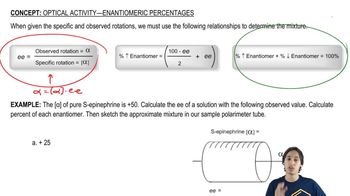
How to solve for the percentage of each enantiomer.

Molecular Models

Molecular models are three-dimensional representations of molecules that help visualize their structure and spatial arrangement. Building these models can aid in understanding complex stereochemistry, including the orientation of substituents around chiral centers. This hands-on approach is particularly useful for grasping the concept of enantiomers and their interactions.
추천 영상:
가이드 코스
08:41
Review of Molecular Orbitals
관련 실천
교과서 질문

Make a model and draw a three-dimensional structure for each compound. Then draw the mirror image of your original structure and determine whether the mirror image is the same compound. Label each structure as being chiral or achiral, and label pairs of enantiomers.

(e)

(f)

1266
views
교과서 질문

Make a model and draw a three-dimensional structure for each compound. Then draw the mirror image of your original structure and determine whether the mirror image is the same compound. Label each structure as being chiral or achiral, and label pairs of enantiomers.

(c) cis- and trans-1,3-dimethylcyclobutane

(d) 2-bromobutane

1673
views
교과서 질문

Draw a three-dimensional structure for each compound, and star all asymmetric carbon atoms. Draw the mirror for each structure, and state whether you have drawn a pair of enantiomers or just the same molecule twice. Build molecular models of any of these examples that seem difficult to you.

(i)

944
views
교과서 질문

For each of the stereocenters (circled) in Figure 5-5,

a. draw the compound with two of the groups on the stereocenter interchanged.

b. give the relationship of the new compound to the original compound.

1844
views
교과서 질문

Draw a three-dimensional structure for each compound, and star all asymmetric carbon atoms. Draw the mirror for each structure, and state whether you have drawn a pair of enantiomers or just the same molecule twice. Build molecular models of any of these examples that seem difficult to you.

(c)

(d) 1-bromo-2-methylbutane

2572
views
교과서 질문

Make a model and draw a three-dimensional structure for each compound. Then draw the mirror image of your original structure and determine whether the mirror image is the same compound. Label each structure as being chiral or achiral, and label pairs of enantiomers.

(a) cis-1,2-dimethylcyclobutane

(b) trans-1,2-dimethylcyclobutane

1507
views