
Ch.5 - Stereochemistry
Wade - Organic Chemistry 9th Edition
Wade9th EditionOrganic ChemistryISBN: 9780135213728당신이 사용하는 게 아니라요?교과서 변경
5장, 문제 2a,b

Make a model and draw a three-dimensional structure for each compound. Then draw the mirror image of your original structure and determine whether the mirror image is the same compound. Label each structure as being chiral or achiral, and label pairs of enantiomers.
(a) cis-1,2-dimethylcyclobutane
(b) trans-1,2-dimethylcyclobutane

검증된 단계별 안내
1
Step 1: Begin by constructing a three-dimensional model of each compound. For cis-1,2-dimethylcyclobutane, place the two methyl groups on adjacent carbons in the cyclobutane ring, ensuring both are on the same side of the plane of the ring. For trans-1,2-dimethylcyclobutane, place the two methyl groups on adjacent carbons, but ensure one is above the plane of the ring and the other is below.
Step 2: Draw the three-dimensional structure of each compound based on the models you created. Use wedge-and-dash notation to represent the spatial arrangement of the substituents (wedge for groups coming out of the plane, dash for groups going behind the plane).
Step 3: Draw the mirror image of each structure. For cis-1,2-dimethylcyclobutane, reflect the positions of the methyl groups across a vertical mirror plane. Similarly, for trans-1,2-dimethylcyclobutane, reflect the positions of the methyl groups across the mirror plane.
Step 4: Compare the original structure and its mirror image for each compound. Determine whether the mirror image is superimposable on the original structure. If the mirror image is not superimposable, the compound is chiral; if it is superimposable, the compound is achiral.
Step 5: Label each structure as chiral or achiral based on your comparison. For chiral compounds, identify the original structure and its mirror image as enantiomers. For achiral compounds, note that the mirror image is identical to the original structure.

비슷한 문제에 대한 검증된 영상 답변:

이 영상 해법은 위 문제에 도움이 된다고 튜터들이 추천한 것입니다.
영상 길이:
5m
도움이 되었나요?

주요 개념

질문에 올바르게 답하기 위해 반드시 이해해야 하는 핵심 개념들은 다음과 같습니다.

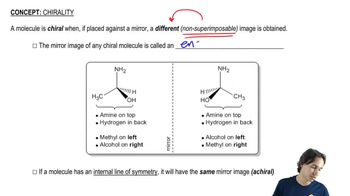
Chirality

Chirality refers to the geometric property of a molecule that makes it non-superimposable on its mirror image. A chiral molecule typically has at least one carbon atom bonded to four different substituents, resulting in two distinct forms known as enantiomers. Understanding chirality is crucial for determining the optical activity and biological interactions of compounds.
추천 영상:
가이드 코스
05:10
What is chirality?

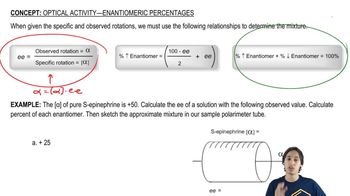
Enantiomers

Enantiomers are a pair of chiral molecules that are mirror images of each other. They possess identical physical properties in an achiral environment but can exhibit different behaviors in chiral environments, such as biological systems. Identifying enantiomers is essential for understanding the specificity of molecular interactions, particularly in pharmaceuticals.
추천 영상:
가이드 코스
03:23
How to solve for the percentage of each enantiomer.

Cis-Trans Isomerism

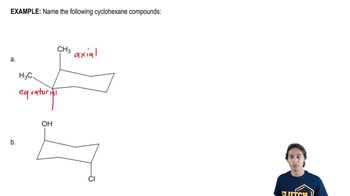
Cis-trans isomerism is a form of stereoisomerism where the relative positioning of substituents differs around a double bond or a ring structure. In the context of cyclobutane derivatives, 'cis' indicates that the methyl groups are on the same side of the ring, while 'trans' indicates they are on opposite sides. This distinction can influence the chirality and overall stability of the compounds.
추천 영상:
가이드 코스
00:44
Is the following cyclohexane cis or trans?