Ch.5 - Stereochemistry
Wade - Organic Chemistry 9th Edition
Wade9th EditionOrganic ChemistryISBN: 9780135213728당신이 사용하는 게 아니라요?교과서 변경
5장, 문제 31e,f

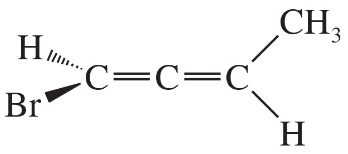
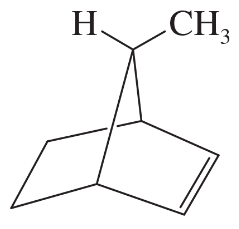
Draw the enantiomer, if any, for each structure.
(e)
(f)

검증된 단계별 안내
1
Step 1: Understand the concept of enantiomers. Enantiomers are stereoisomers that are non-superimposable mirror images of each other. They occur when a molecule has a chiral center, typically a carbon atom bonded to four different groups.
Step 2: Analyze structure (e). The molecule contains a chiral center at the carbon bonded to H, Br, and the two different alkene groups. To draw the enantiomer, reverse the wedge and dash bonds for the H and Br groups. This will create the mirror image of the original structure.
Step 3: Analyze structure (f). The molecule is a bicyclic compound with a methyl group and hydrogens attached. Check for chirality by identifying if the substituents on the bridgehead carbon are arranged in a way that makes the molecule non-superimposable on its mirror image.
Step 4: If structure (f) is chiral, draw its enantiomer by flipping the spatial arrangement of the substituents (e.g., reverse the positions of the methyl group and hydrogen on the chiral center). Ensure the mirror image is non-superimposable.
Step 5: Verify the enantiomers by confirming that the original structure and its mirror image cannot be superimposed. This ensures the correctness of the drawn enantiomers.

비슷한 문제에 대한 검증된 영상 답변:

이 영상 해법은 위 문제에 도움이 된다고 튜터들이 추천한 것입니다.
영상 길이:
3m
도움이 되었나요?

주요 개념

질문에 올바르게 답하기 위해 반드시 이해해야 하는 핵심 개념들은 다음과 같습니다.

Enantiomers

Enantiomers are a type of stereoisomer that are non-superimposable mirror images of each other. They typically arise in molecules that contain a chiral center, which is a carbon atom bonded to four different substituents. Understanding enantiomers is crucial for predicting the behavior of molecules in biological systems, as they can have vastly different properties and activities.
추천 영상:
03:23
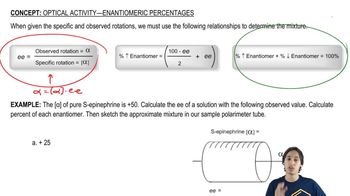
How to solve for the percentage of each enantiomer.

Chirality

Chirality refers to the geometric property of a molecule that makes it non-superimposable on its mirror image. A chiral molecule usually has at least one carbon atom bonded to four distinct groups, creating two different configurations. Recognizing chirality is essential for determining whether a compound has enantiomers and for understanding its potential interactions in biological contexts.
추천 영상:
05:10
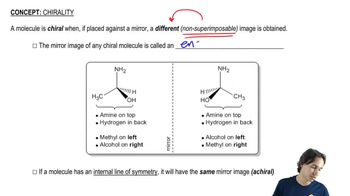
What is chirality?

Cyclic and Acyclic Structures

Cyclic structures are closed-loop molecules, while acyclic structures are open-chain molecules. The presence of double bonds and the arrangement of substituents in acyclic structures can influence their chirality. In the context of the provided question, analyzing the structure's connectivity and substituents is vital for identifying any potential enantiomers.
추천 영상:
06:23
Monosaccharides - Forming Cyclic Hemiacetals