Ch.5 - Stereochemistry
Wade - Organic Chemistry 9th Edition
Wade9th EditionOrganic ChemistryISBN: 9780135213728당신이 사용하는 게 아니라요?교과서 변경
5장, 문제 32b

Calculate the specific rotations of the following samples taken at 25 °C using the sodium D line.
b. 0.050 g of sample is dissolved in 2.0 mL of ethanol, and this solution is placed in a 2.0-cm polarimeter tube. The observed rotation is clockwise 0.043°.

검증된 단계별 안내
1
Understand the formula for specific rotation: \( [\alpha] = \frac{\alpha_{\text{obs}}}{l \cdot c} \), where \( [\alpha] \) is the specific rotation, \( \alpha_{\text{obs}} \) is the observed rotation, \( l \) is the path length in decimeters (dm), and \( c \) is the concentration in grams per milliliter (g/mL).
Convert the path length \( l \) from centimeters to decimeters. Since 1 dm = 10 cm, divide the given path length (2.0 cm) by 10 to get \( l \) in dm.
Calculate the concentration \( c \) of the solution. Use the formula \( c = \frac{\text{mass of sample}}{\text{volume of solution}} \). The mass of the sample is 0.050 g, and the volume of the solution is 2.0 mL.
Substitute the values for \( \alpha_{\text{obs}} \) (0.043°), \( l \) (in dm), and \( c \) (in g/mL) into the specific rotation formula \( [\alpha] = \frac{\alpha_{\text{obs}}}{l \cdot c} \).
Simplify the expression to calculate the specific rotation \( [\alpha] \). Ensure the units are consistent throughout the calculation.

비슷한 문제에 대한 검증된 영상 답변:

이 영상 해법은 위 문제에 도움이 된다고 튜터들이 추천한 것입니다.
영상 길이:
2m

주요 개념

질문에 올바르게 답하기 위해 반드시 이해해야 하는 핵심 개념들은 다음과 같습니다.

Specific Rotation

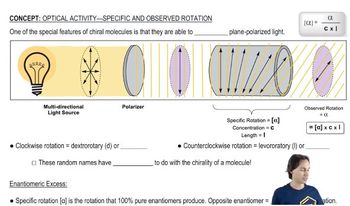
Specific rotation is a property of chiral compounds that quantifies their ability to rotate plane-polarized light. It is defined as the observed rotation of light (in degrees) divided by the path length of the sample (in decimeters) and the concentration of the solution (in grams per milliliter). This value is temperature and wavelength dependent, typically measured at 20 °C or 25 °C using the sodium D line (589 nm).
추천 영상:
05:43
Specific rotation vs. observed rotation.

Polarimetry

Polarimetry is an analytical technique used to measure the optical activity of chiral substances. A polarimeter consists of a light source, a polarizer, a sample tube, and an analyzer. When plane-polarized light passes through a sample, the rotation of the light is measured, allowing for the determination of the specific rotation of the compound. This technique is crucial in characterizing and quantifying chiral molecules.

Concentration and Path Length

In the context of specific rotation, concentration refers to the amount of solute (in grams) per unit volume of solvent (in milliliters), while path length is the distance the light travels through the sample (in decimeters). Both factors are essential for calculating specific rotation, as they directly influence the observed rotation. The formula for specific rotation incorporates these variables, emphasizing their importance in polarimetric measurements.
추천 영상:
01:53
Learning Alkane Prefixes up to 12 Carbons in Length