Ch.5 - Stereochemistry
Wade - Organic Chemistry 9th Edition
Wade9th EditionOrganic ChemistryISBN: 9780135213728당신이 사용하는 게 아니라요?교과서 변경
5장, 문제 15g

Draw three-dimensional representations of the following compounds. Which have asymmetric carbon atoms? Which have no asymmetric carbons but are chiral anyway? Use your models for parts (a) through (d) and any others that seem unclear.
(g) Three-dimensional representation of a compound with two deuterium (D) and two hydrogen (H) atoms, illustrating chirality concepts.

검증된 단계별 안내
1
Step 1: Analyze the given structure. The compound consists of two benzene rings fused together, forming a biphenyl system. The substituents on the biphenyl are two deuterium atoms (D) and two hydrogen atoms (H) attached to the ortho positions of each benzene ring.
Step 2: Determine the presence of asymmetric carbon atoms. An asymmetric carbon atom is a carbon bonded to four different groups. In this structure, there are no carbon atoms bonded to four distinct groups, so there are no asymmetric carbons.
Step 3: Evaluate chirality. A molecule is chiral if it is non-superimposable on its mirror image. In this case, the biphenyl system can be chiral due to restricted rotation around the single bond connecting the two benzene rings, provided the substituents (D and H) create a non-superimposable arrangement.
Step 4: Consider the spatial arrangement of the substituents. The bulky nature of the benzene rings and the substituents (D and H) prevent free rotation, locking the molecule into a specific three-dimensional configuration. This can result in chirality even without asymmetric carbons.
Step 5: Use molecular models to visualize the three-dimensional structure. Construct a model of the compound to confirm that the arrangement of substituents leads to chirality. Verify that the molecule is non-superimposable on its mirror image, confirming its chiral nature despite lacking asymmetric carbons.

비슷한 문제에 대한 검증된 영상 답변:

이 영상 해법은 위 문제에 도움이 된다고 튜터들이 추천한 것입니다.
영상 길이:
4m
도움이 되었나요?

주요 개념

질문에 올바르게 답하기 위해 반드시 이해해야 하는 핵심 개념들은 다음과 같습니다.

Asymmetric Carbon Atoms

Asymmetric carbon atoms, or chiral centers, are carbon atoms that are bonded to four different substituents. This unique arrangement allows for the existence of non-superimposable mirror images, known as enantiomers. Identifying these centers is crucial for determining the chirality of a compound, which can significantly influence its chemical behavior and interactions.
추천 영상:
01:44
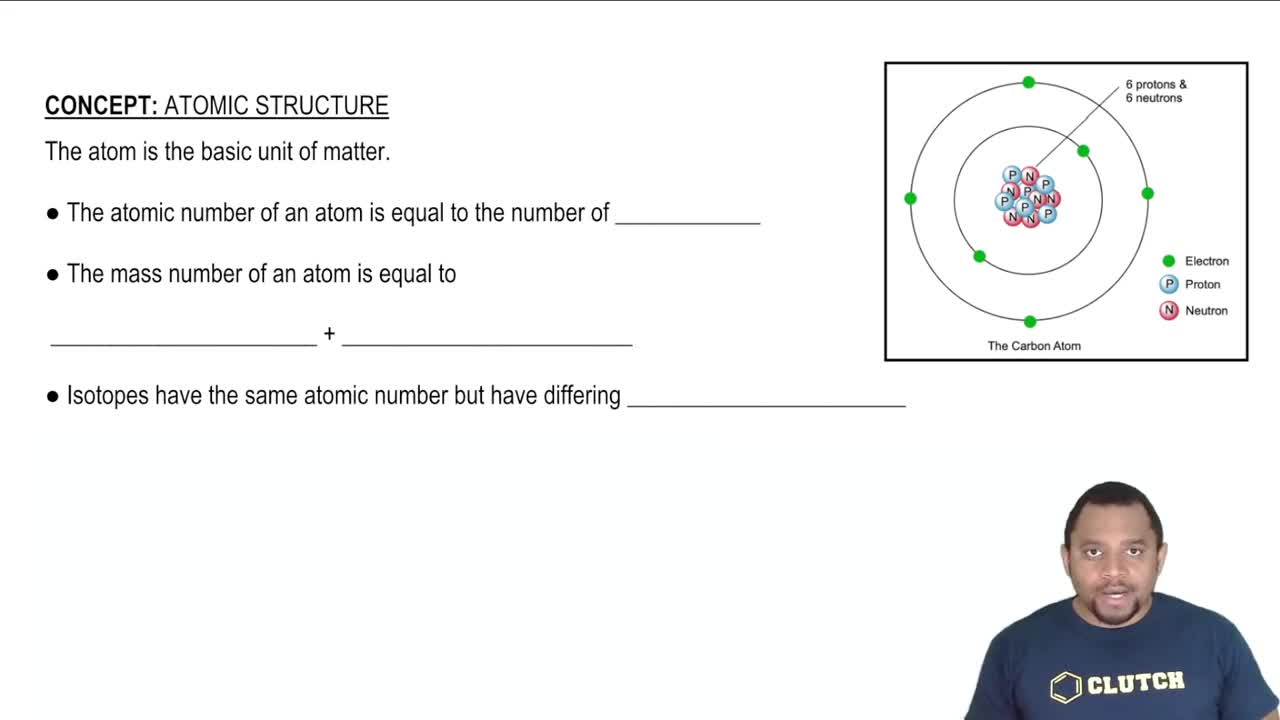
The difference between atomic numbers and atomic mass.

Chirality

Chirality refers to the geometric property of a molecule that makes it non-superimposable on its mirror image. A molecule can be chiral even without asymmetric carbon atoms if it has other elements of symmetry that create distinct spatial arrangements. This concept is essential in organic chemistry, particularly in the study of stereochemistry and the behavior of molecules in biological systems.
추천 영상:
05:10
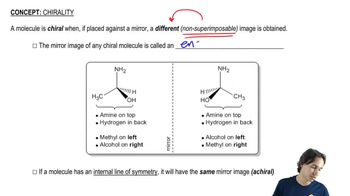
What is chirality?

Three-Dimensional Representations

Three-dimensional representations of molecules, such as ball-and-stick models or space-filling models, provide a visual understanding of molecular geometry and spatial orientation. These models help in identifying chiral centers and understanding the overall shape of the molecule, which is critical for predicting reactivity and interactions in chemical reactions.
추천 영상:
05:09
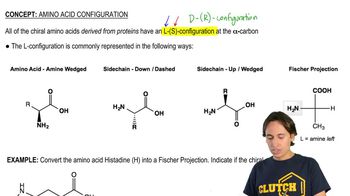
Representations of L-Configuration
관련 실천
교과서 질문

For each set of examples, make a model of the first structure, and indicate the relationship of each of the other structures to the first structure. Examples of relationships: same compound, enantiomer, structural isomer.

(a)

1435
views

교과서 질문

Draw three-dimensional representations of the following compounds. Which have asymmetric carbon atoms? Which have no asymmetric carbons but are chiral anyway? Use your models for parts (a) through (d) and any others that seem unclear.

(c)

(d)

824
views
교과서 질문

Draw three-dimensional representations of the following compounds. Which have asymmetric carbon atoms? Which have no asymmetric carbons but are chiral anyway? Use your models for parts (a) through (d) and any others that seem unclear.

(e)

(f)

882
views
교과서 질문

For each set of examples, make a model of the first structure, and indicate the relationship of each of the other structures to the first structure. Examples of relationships: same compound, enantiomer, structural isomer.

(c)

818
views
교과서 질문

Draw a Fischer projection for each compound. Remember that the cross represents an asymmetric carbon atom, and the carbon chain should be along the vertical, with the IUPAC numbering from top to bottom.

(a) (S)-propane-1,2-diol

(b) (R)-2-bromobutan-1-ol

1591
views
교과서 질문

Draw three-dimensional representations of the following compounds. Which have asymmetric carbon atoms? Which have no asymmetric carbons but are chiral anyway? Use your models for parts (a) through (d) and any others that seem unclear.

(a)

(b)

1001
views