

Ch.5 - Stereochemistry
Wade - Organic Chemistry 9th Edition
Wade9th EditionOrganic ChemistryISBN: 9780135213728당신이 사용하는 게 아니라요?교과서 변경
5장, 문제 16a

For each set of examples, make a model of the first structure, and indicate the relationship of each of the other structures to the first structure. Examples of relationships: same compound, enantiomer, structural isomer.
(a)

검증된 단계별 안내
1
Step 1: Analyze the first structure in the set (A in the first image and the first structure in the second image). This will serve as the reference structure. Identify its functional groups, stereochemistry, and connectivity of atoms.
Step 2: Compare the second structure (B in the first image and the second structure in the second image) to the reference structure. Check for differences in connectivity, functional groups, or stereochemistry. Determine if it is the same compound, an enantiomer (mirror image), or a structural isomer (different connectivity).
Step 3: Compare the third structure (C in the first image and the third structure in the second image) to the reference structure. Again, analyze connectivity, functional groups, and stereochemistry to classify the relationship.
Step 4: Compare the fourth structure (D in the first image and the fourth structure in the second image) to the reference structure. Follow the same process to determine the relationship.
Step 5: Summarize the relationships of all structures to the reference structure, clearly stating whether each is the same compound, an enantiomer, or a structural isomer based on the analysis.

비슷한 문제에 대한 검증된 영상 답변:

이 영상 해법은 위 문제에 도움이 된다고 튜터들이 추천한 것입니다.
영상 길이:
7m
도움이 되었나요?

주요 개념

질문에 올바르게 답하기 위해 반드시 이해해야 하는 핵심 개념들은 다음과 같습니다.

Structural Isomers

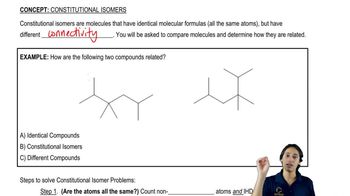
Structural isomers are compounds that have the same molecular formula but differ in the connectivity of their atoms. This means that the arrangement of atoms in the molecule is different, leading to distinct compounds with different properties. In the provided structures, some represent structural isomers of each other due to variations in how functional groups are attached to the carbon skeleton.
추천 영상:
01:10
What is a constitutional isomer?

Enantiomers

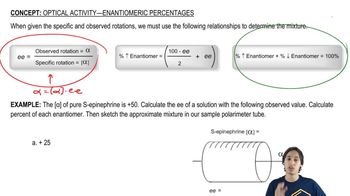
Enantiomers are a type of stereoisomer that are non-superimposable mirror images of each other. They typically arise in molecules that contain a chiral center, where four different substituents are attached to a carbon atom. In the context of the question, identifying enantiomers involves recognizing pairs of structures that are mirror images, which can have significant implications in biological activity and chemical reactivity.
추천 영상:
03:23
How to solve for the percentage of each enantiomer.

Functional Groups

Functional groups are specific groups of atoms within molecules that are responsible for the characteristic chemical reactions of those molecules. Common functional groups include hydroxyl (-OH), carboxyl (-COOH), and methyl (-CH3). Understanding functional groups is essential for analyzing the relationships between different organic compounds, as they dictate the reactivity and properties of the molecules involved.
추천 영상:
02:36
Identifying Functional Groups
관련 실천
교과서 질문

Draw a Fischer projection for each compound. Remember that the cross represents an asymmetric carbon atom, and the carbon chain should be along the vertical, with the IUPAC numbering from top to bottom.

(c) (S)-1,2-dibromobutane

(d) (R)-butan-2-ol

980
views
교과서 질문

Draw three-dimensional representations of the following compounds. Which have asymmetric carbon atoms? Which have no asymmetric carbons but are chiral anyway? Use your models for parts (a) through (d) and any others that seem unclear.

(c)

(d)

824
views
교과서 질문

Draw three-dimensional representations of the following compounds. Which have asymmetric carbon atoms? Which have no asymmetric carbons but are chiral anyway? Use your models for parts (a) through (d) and any others that seem unclear.

(e)

(f)

882
views
교과서 질문

For each set of examples, make a model of the first structure, and indicate the relationship of each of the other structures to the first structure. Examples of relationships: same compound, enantiomer, structural isomer.

(c)

818
views
교과서 질문

Draw a Fischer projection for each compound. Remember that the cross represents an asymmetric carbon atom, and the carbon chain should be along the vertical, with the IUPAC numbering from top to bottom.

(a) (S)-propane-1,2-diol

(b) (R)-2-bromobutan-1-ol

1591
views
교과서 질문

Draw three-dimensional representations of the following compounds. Which have asymmetric carbon atoms? Which have no asymmetric carbons but are chiral anyway? Use your models for parts (a) through (d) and any others that seem unclear.

(g)

1424
views