
Ch.5 - Stereochemistry
Wade - Organic Chemistry 9th Edition
Wade9th EditionOrganic ChemistryISBN: 9780135213728당신이 사용하는 게 아니라요?교과서 변경
5장, 문제 5a,b,c

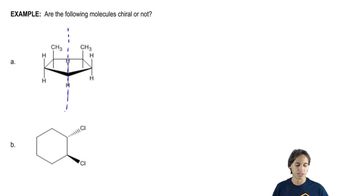
For each compound, determine whether the molecule has an internal mirror plane of symmetry. If it does, draw the mirror plane on a three-dimensional drawing of the molecule. If the molecule does not have an internal mirror plane, determine whether the structure is chiral.
(a) methane
(b) cis-1,2-dibromocyclobutane
(c) trans-1,2-dibromocyclobutane

검증된 단계별 안내
1
Step 1: Understand the concept of a mirror plane of symmetry. A molecule has a mirror plane of symmetry if it can be divided into two halves that are mirror images of each other. If a molecule lacks a mirror plane, it may be chiral, meaning it is non-superimposable on its mirror image.
Step 2: Analyze methane (CH₄). Methane is a tetrahedral molecule with four identical hydrogen atoms bonded to a central carbon atom. Due to its symmetrical geometry, methane has multiple mirror planes of symmetry. Draw a three-dimensional representation of methane and indicate one of the mirror planes passing through the carbon atom and two hydrogen atoms.
Step 3: Examine cis-1,2-dibromocyclobutane. In the cis configuration, the two bromine atoms are on the same side of the cyclobutane ring. This arrangement creates a plane of symmetry that divides the molecule into two mirror-image halves. Draw a three-dimensional representation of cis-1,2-dibromocyclobutane and indicate the mirror plane passing through the ring and bisecting the bromine atoms.
Step 4: Investigate trans-1,2-dibromocyclobutane. In the trans configuration, the two bromine atoms are on opposite sides of the cyclobutane ring. This arrangement eliminates any internal mirror plane of symmetry. Since the molecule lacks a mirror plane and is non-superimposable on its mirror image, it is chiral. Draw a three-dimensional representation of trans-1,2-dibromocyclobutane and confirm its chirality by showing that it has no mirror plane.
Step 5: Summarize the findings. Methane has multiple mirror planes and is achiral. Cis-1,2-dibromocyclobutane has a mirror plane and is achiral. Trans-1,2-dibromocyclobutane lacks a mirror plane and is chiral. Ensure the three-dimensional drawings clearly illustrate the symmetry or lack thereof for each molecule.

비슷한 문제에 대한 검증된 영상 답변:

이 영상 해법은 위 문제에 도움이 된다고 튜터들이 추천한 것입니다.
영상 길이:
4m
도움이 되었나요?

주요 개념

질문에 올바르게 답하기 위해 반드시 이해해야 하는 핵심 개념들은 다음과 같습니다.

Symmetry in Molecules

Symmetry in molecules refers to the arrangement of atoms in a way that allows for certain operations, such as reflection, rotation, or inversion, to yield an indistinguishable configuration. An internal mirror plane of symmetry divides a molecule into two mirror-image halves. Identifying symmetry is crucial for understanding molecular properties, including chirality.
추천 영상:
가이드 코스
00:25
Determining Chirality with Plane of Symmetry

Chirality

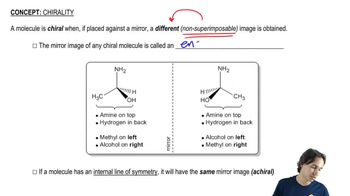
Chirality is a property of a molecule that makes it non-superimposable on its mirror image, much like left and right hands. A chiral molecule typically has at least one carbon atom bonded to four different substituents, leading to two distinct enantiomers. Recognizing chirality is essential for predicting the behavior of molecules in biological systems and their interactions.
추천 영상:
가이드 코스
05:10
What is chirality?

Drawing Molecular Structures

Drawing molecular structures involves representing the three-dimensional arrangement of atoms in a molecule on a two-dimensional plane. This includes using wedge and dash notation to indicate bonds that are oriented above or below the plane of the paper. Accurately depicting molecular geometry is vital for visualizing symmetry elements and understanding the spatial relationships between atoms.
추천 영상:
가이드 코스
03:44
The 7 Rules of Drawing Molecular Orbitals
관련 실천
교과서 질문
For each of the compounds described by the following names,1. draw a three-dimensional representation.2. star (*) each chiral center.3. draw any planes of symmetry.4. draw any enantiomer.5. draw any diastereomers.6. label each structure you have drawn as chiral or achiral.c. (2R,3S)-2,3-dibromohexaned. (1R,2R)-1,2-dibromocyclohexane
1695
views
교과서 질문
Which of the following pairs of compounds could be separated by recrystallization or distillation?b. and
1109
views
교과서 질문

For each compound, determine whether the molecule has an internal mirror plane of symmetry. If it does, draw the mirror plane on a three-dimensional drawing of the molecule. If the molecule does not have an internal mirror plane, determine whether the structure is chiral.

(d) 1,2-dichloropropane

(e)

1828
views
교과서 질문
For each compound, determine whether the molecule has an internal mirror plane of symmetry. If it does, draw the mirror plane on a three-dimensional drawing of the molecule. If the molecule does not have an internal mirror plane, determine whether the structure is chiral.a. Methaneb. cis-1,2-dibromocyclobutanec. trans-1,2-dibromocyclobutane
1537
views
교과서 질문

For each compound, determine whether the molecule has an internal mirror plane of symmetry. If it does, draw the mirror plane on a three-dimensional drawing of the molecule. If the molecule does not have an internal mirror plane, determine whether the structure is chiral.

(h)

862
views
교과서 질문
A solution of pure (S)-2-iodobutane ([α] = +15.90° ) in acetone is allowed to react with radioactive iodide, 131I-, until 1.0% of the iodobutane contains radioactive iodine. The specific rotation of this recovered iodobutane is found to be +15.58°. a. Determine the percentages of (R)- and (S)-2-iodobutane in the product mixture.
1861
views